How a multi-package Python monorepo composes LLM components into runnable pipelines and agents.
You have five model providers in your stack, three vector stores, and a tool that fetches URLs from user input. Each provider has its own SDK, its own message format, its own error semantics. Your application code is a tangle of conditional imports and adapter functions, and every new integration means rewriting the glue. LangChain exists to replace that glue with a single interface.
The repository at https://github.com/langchain-ai/langchain is a multi-package Python monorepo, actively maintained with frequent releases and a large contributor base. It is not a small library: the core package alone defines the Runnable interface, message types, tracing, and serialization, while separate packages handle legacy chains, the newer agent framework, and provider-specific integrations.
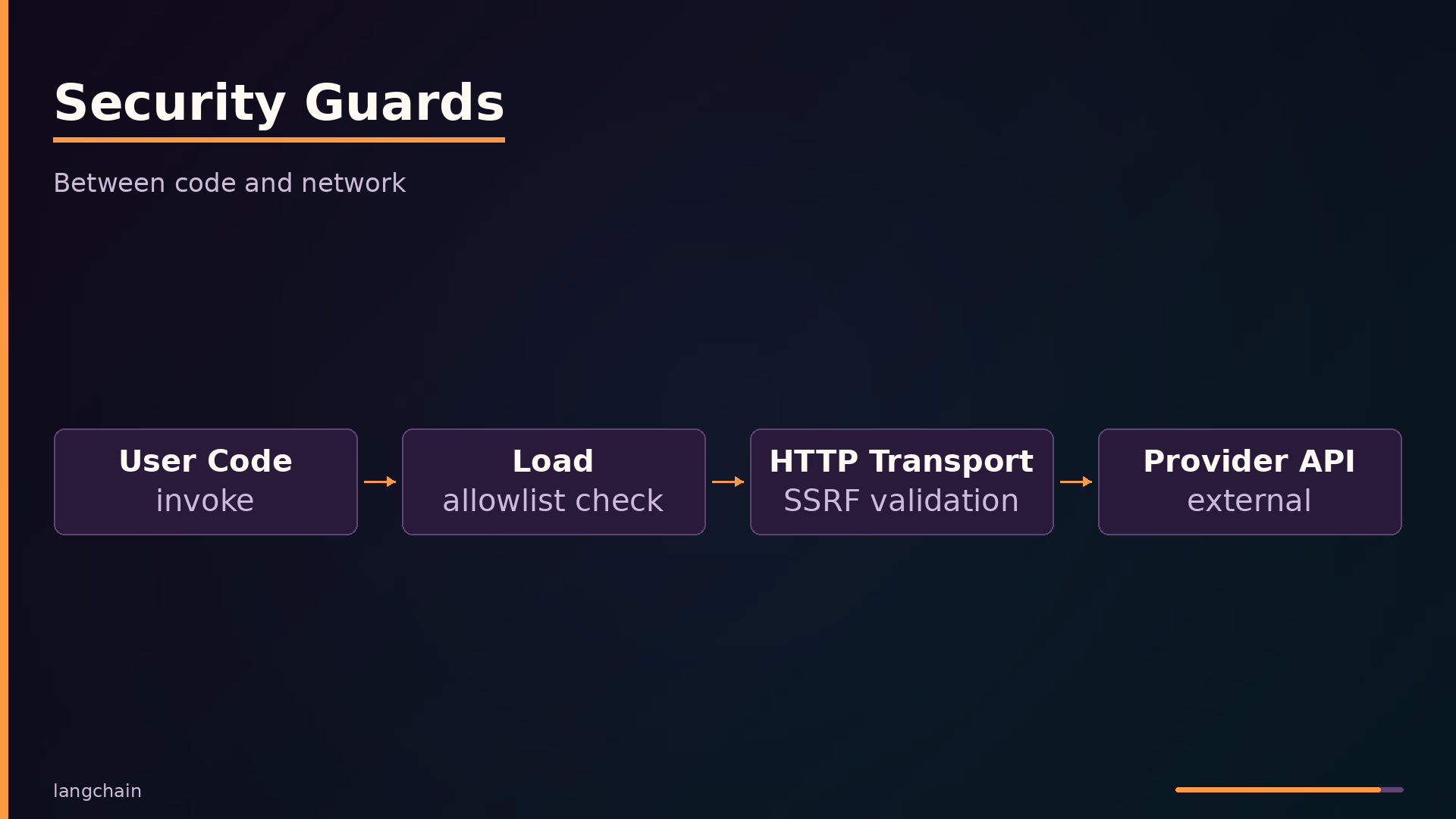
By the end of this article you will understand what actually executes when you call model.invoke("Hello") — the runnable pipeline, the middleware stack that wraps model calls, and the security guards that sit between your code and the network. You will also see where the framework’s abstractions help and where they add indirection you should know about before depending on them in production.
What LangChain Is (and Is Not)
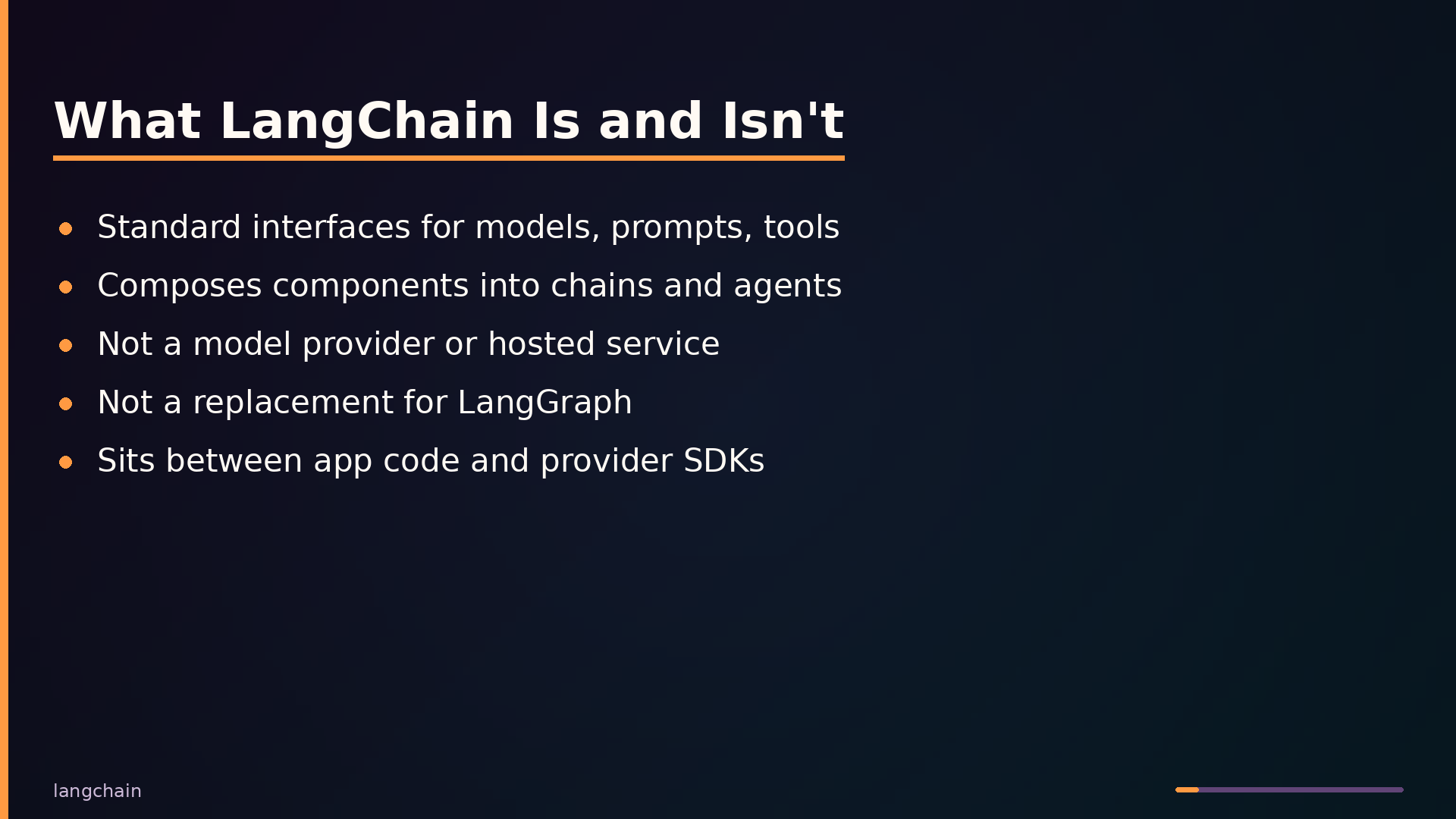
LangChain is a Python framework that provides standard interfaces for LLM components—models, prompts, tools, and memory—and composes them into chains and agents. Its core abstraction is the Runnable interface, which defines a uniform API for synchronous and asynchronous invocation, batching, and streaming. This lets developers swap model providers, vector stores, or parsers without rewriting application code.
LangChain is not a model provider, a hosted service, or a low-level ML library. It does not train models or implement inference; it abstracts over provider APIs. It also is not a replacement for LangGraph, which is a separate orchestration framework for stateful agent graphs. LangChain sits between application code and provider SDKs, translating developer intent into provider-specific calls.
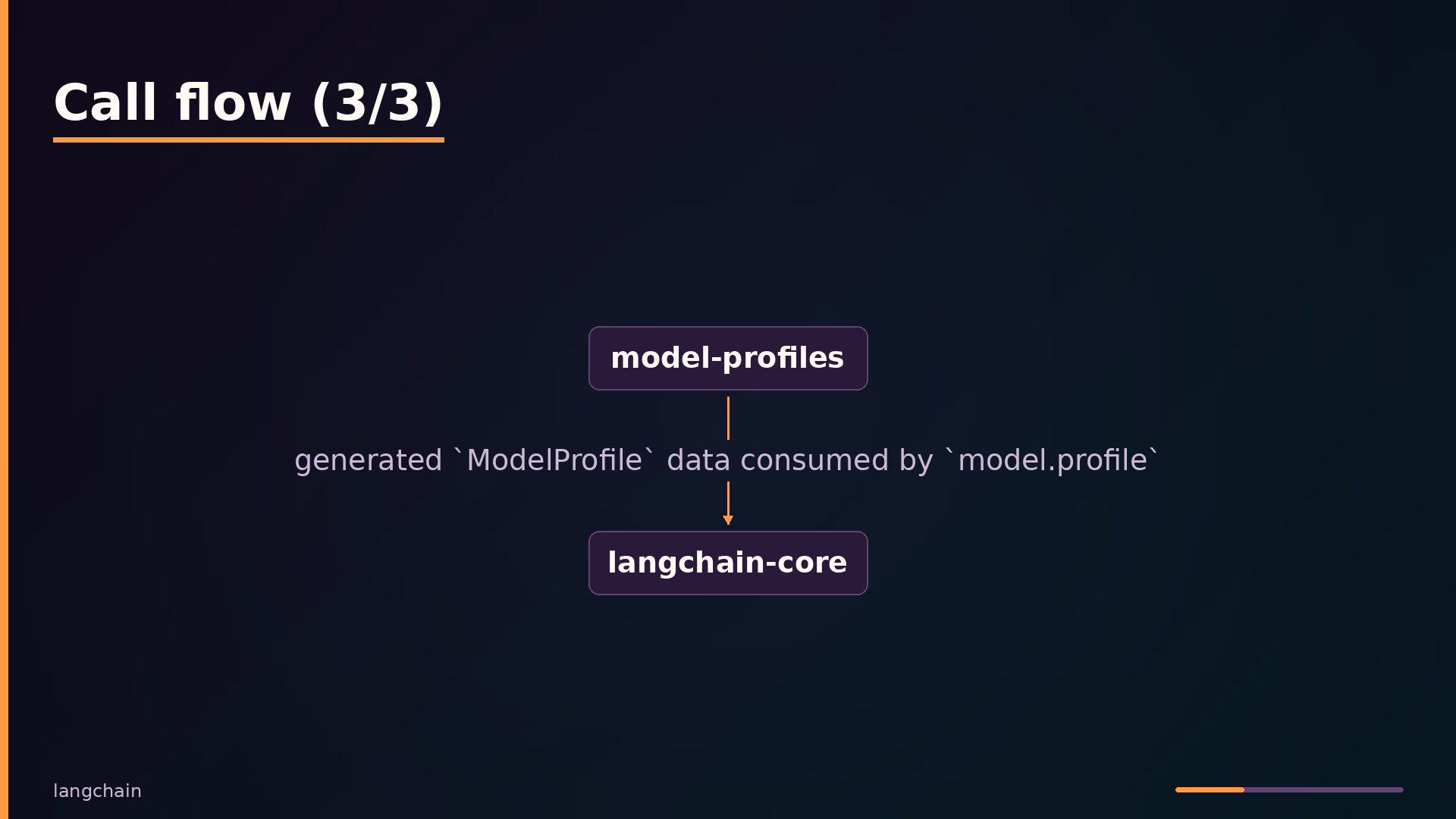
The project is a multi-package monorepo. langchain-core holds the foundational abstractions: messages, runnables, prompts, output parsers, and tracing. langchain_v1 is the newer agent framework built on LangGraph, with middleware for model fallback, retry, and call limits. langchain_classic contains the legacy chains and document loaders, with deprecated imports redirecting to langchain_community. Partner packages such as langchain-openai and langchain-anthropic are separate PyPI distributions providing provider-specific implementations. Tooling packages include model-profiles for generating model capability metadata and standard-tests for integration conformance suites.
The framework is under active development. Recent releases include langchain 1.3.17 and langchain-core 1.6.0, with a large contributor base. This velocity means APIs evolve quickly; the separation of core from integrations is designed to keep the core stable while the ecosystem grows.
Architecture: From Runnable to Middleware to Provider
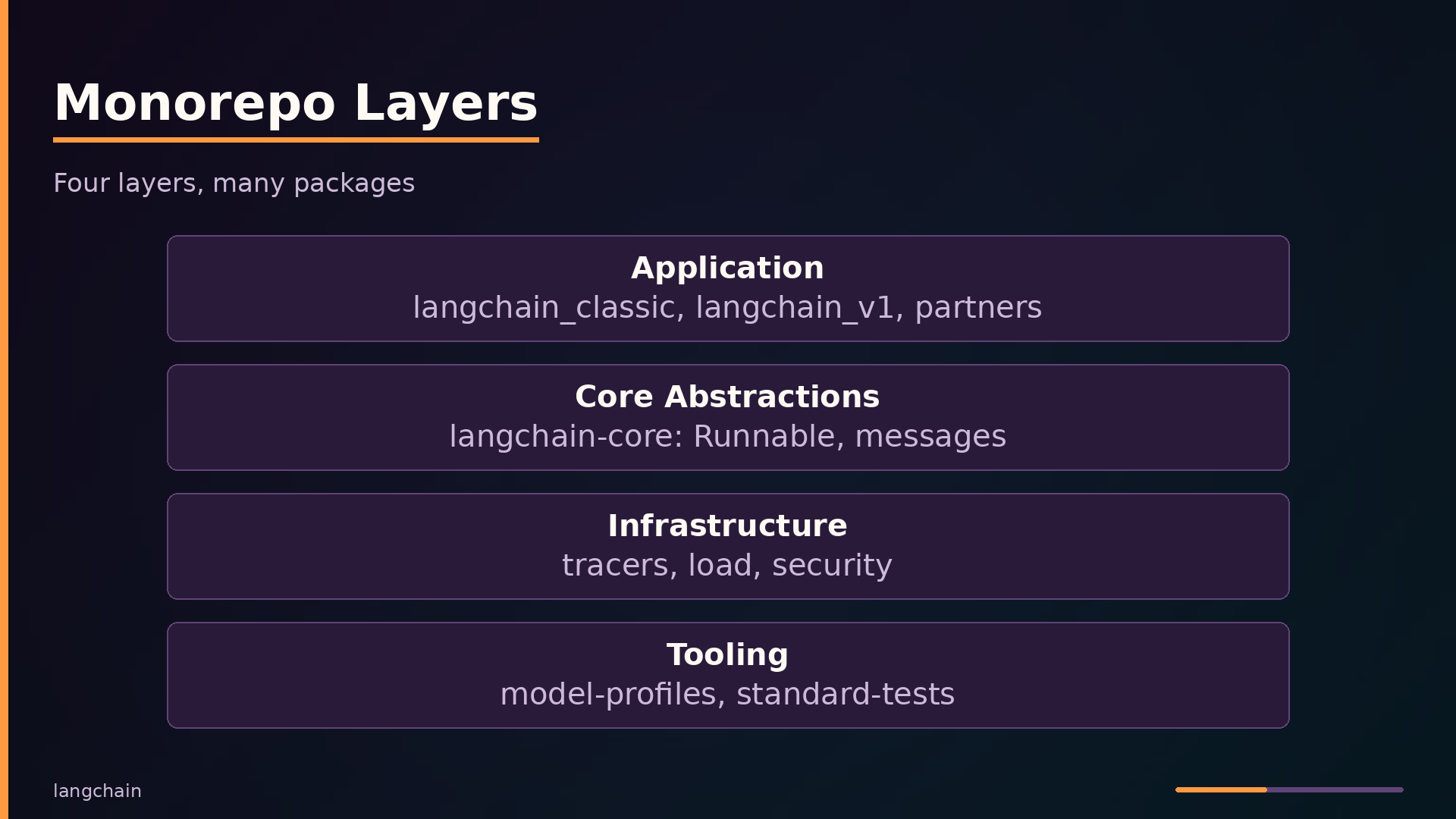
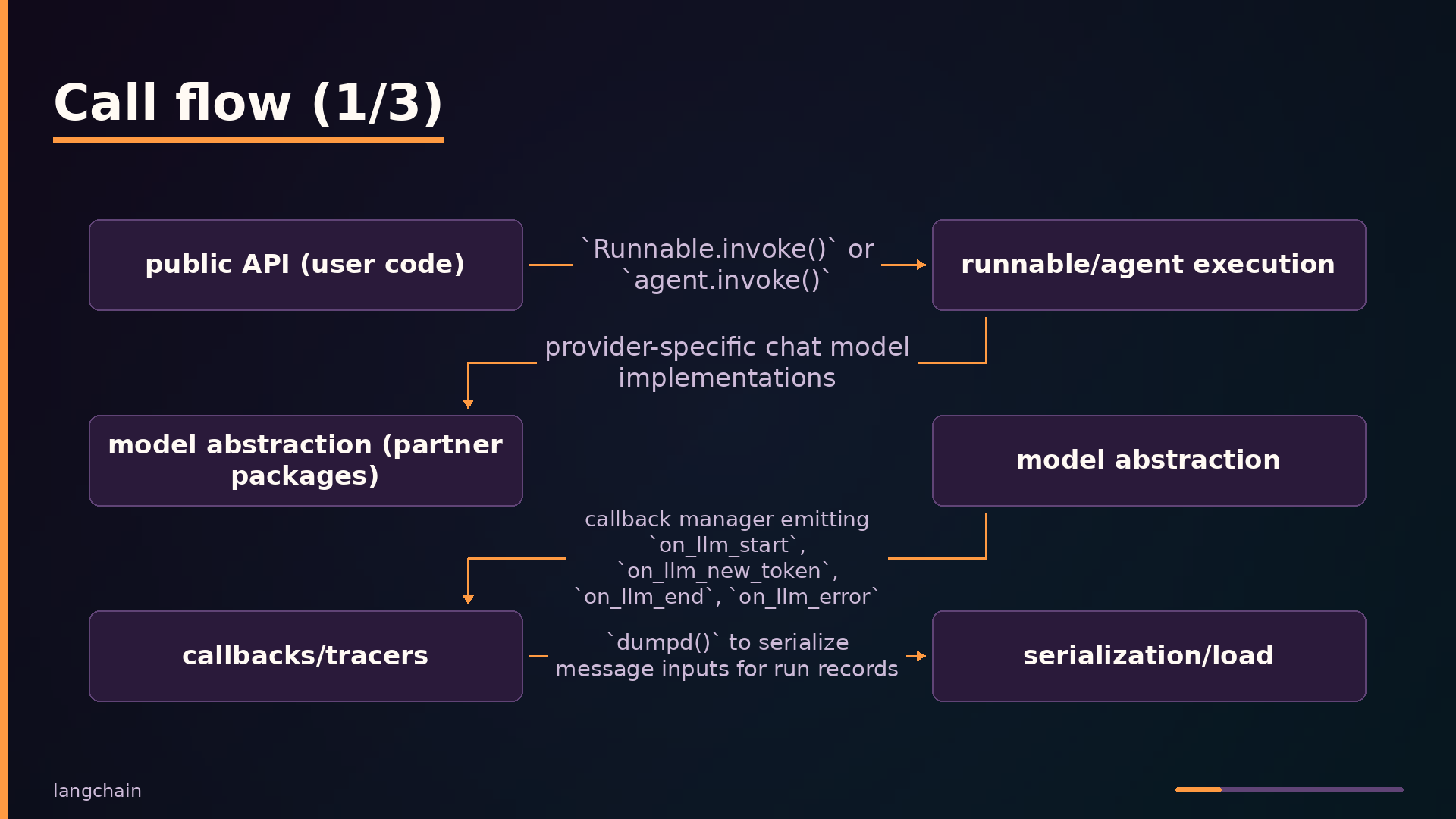
LangChain’s monorepo is organized into four layers. The application layer holds langchain_classic (legacy chains), langchain_v1 (the modern agent framework), and partner packages like langchain-openai and langchain-anthropic. The core abstraction layer is langchain-core, which defines the Runnable interface, messages, prompts, and output parsers. The infrastructure layer contains tracers, serialization/load utilities, and security components. The tooling layer provides model-profiles (a CLI for generating model capability metadata) and standard-tests (shared conformance test suites for integrations).
At the heart of the architecture is the Runnable interface in langchain-core. It defines sync (invoke, batch, stream) and async (ainvoke, abatch, astream) execution methods, plus configurable fields. Every component—chat models, output parsers, prompts, tools—implements this interface, which is what makes them composable with the | operator.
| |
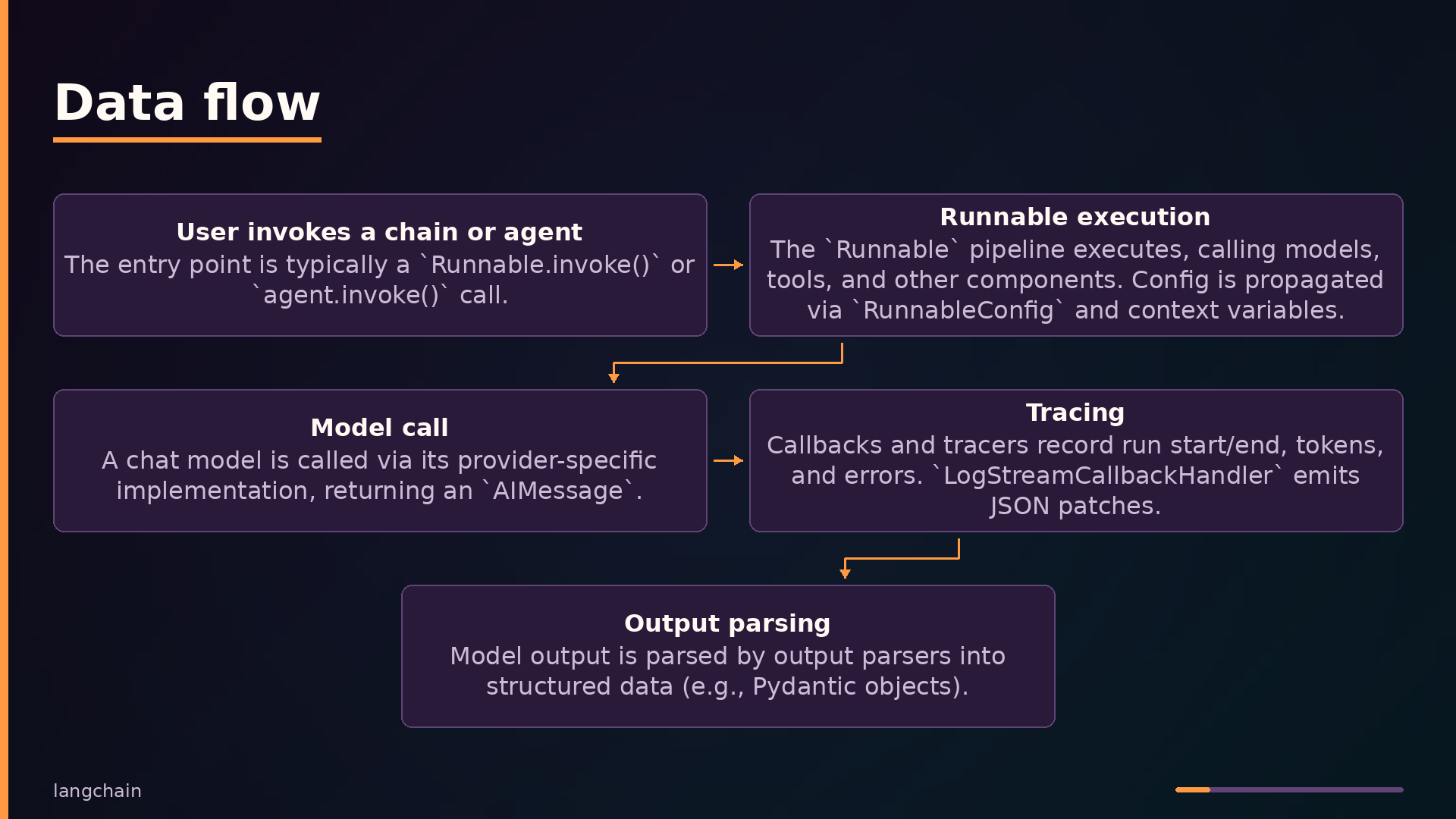
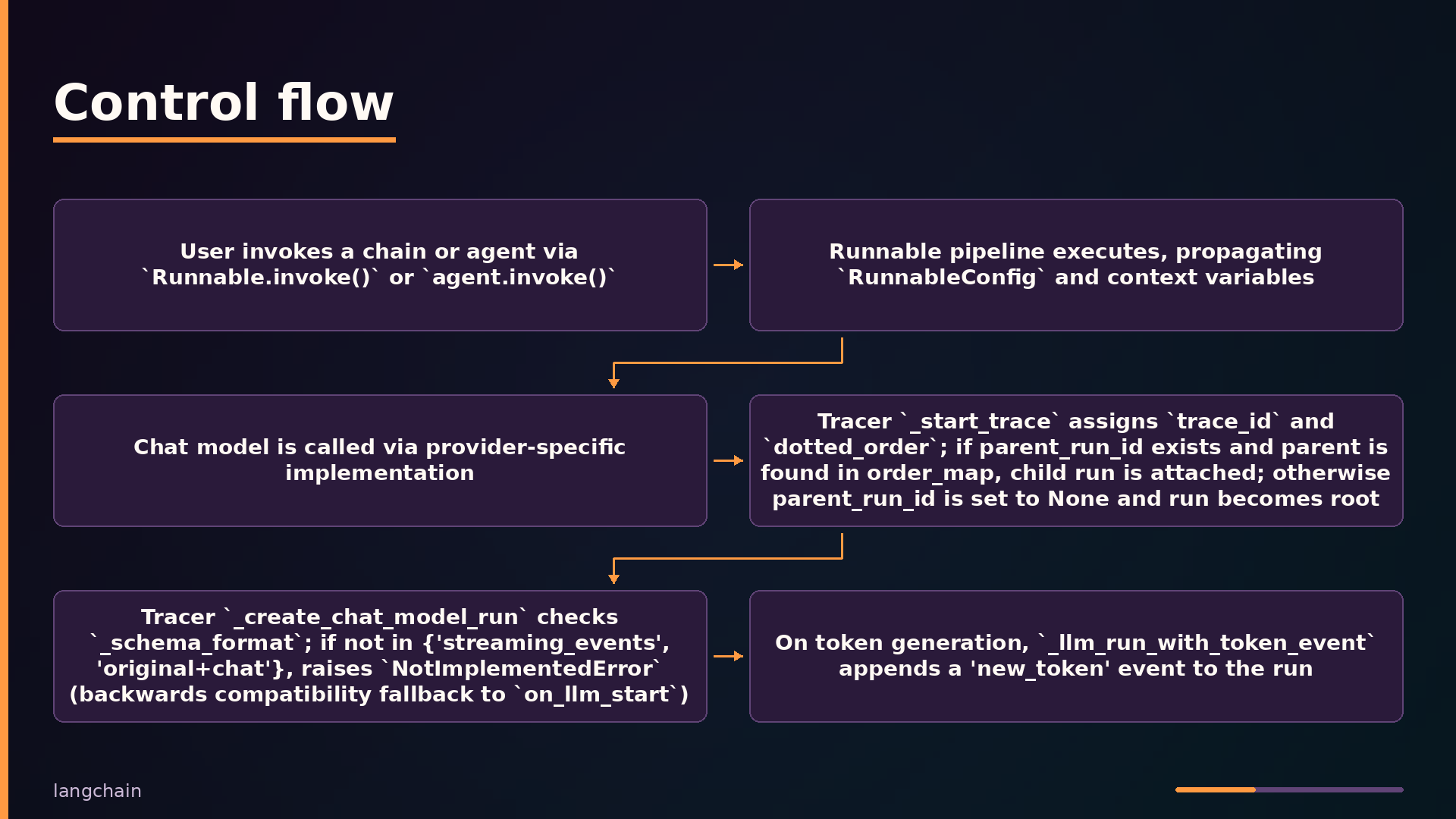
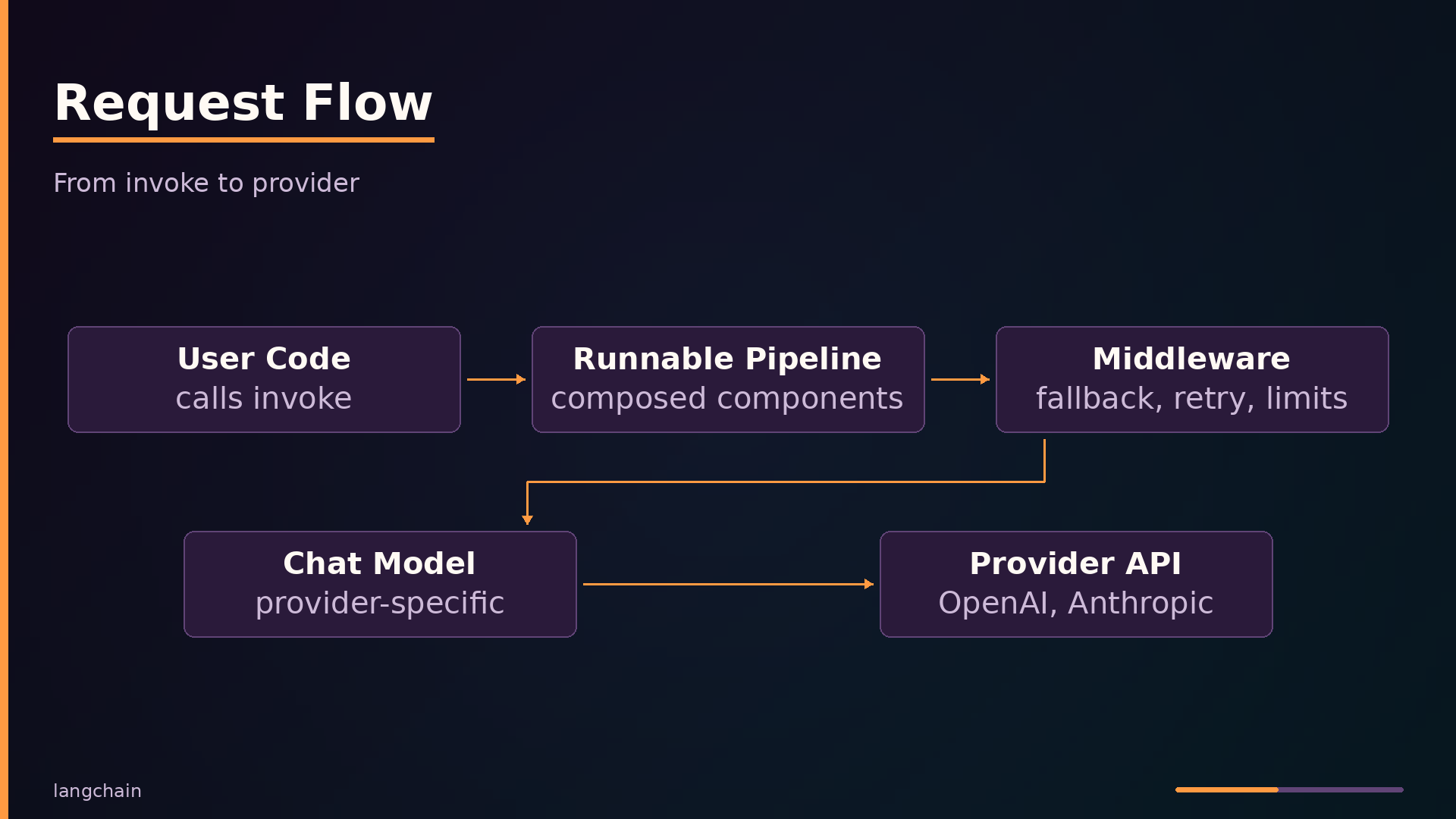
A request flows through the system as follows. User code calls Runnable.invoke(), which executes the pipeline. The pipeline calls a chat model through its provider-specific implementation, which makes an HTTP request to the provider API. Throughout execution, callbacks and tracers record run start/end, tokens, and errors. LogStreamCallbackHandler emits JSON patches that reconstruct run state incrementally. Finally, output parsers convert the model’s AIMessage into structured data such as Pydantic objects.
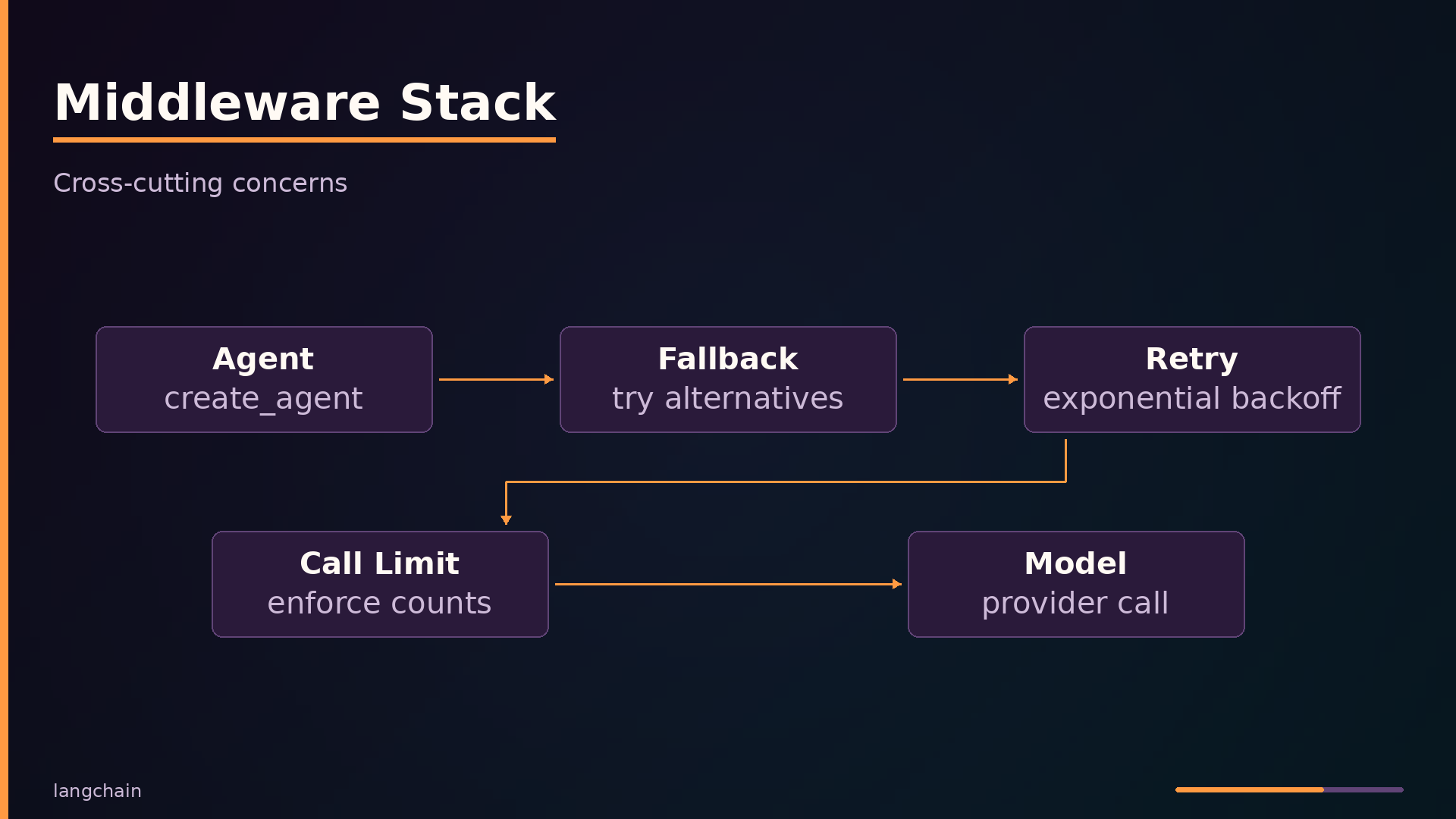
Control flow is handled by middleware in langchain_v1. ModelFallbackMiddleware tries alternative models in sequence on error, sanitizing Anthropic cache_control markers when the fallback model is not Anthropic-compatible. ModelRetryMiddleware applies exponential backoff with jitter based on a retry_on predicate. ModelCallLimitMiddleware checks thread- and run-level call counts before each model call and can jump to the end or raise an error.
Configuration propagates through the pipeline via RunnableConfig, which is carried by a ContextVar (var_child_runnable_config) so child runnables inherit config without explicit passing. This context-variable mechanism is what lets middleware and tracers observe the execution without threading config parameters through every call signature.
Key Features: Solving Real Problems
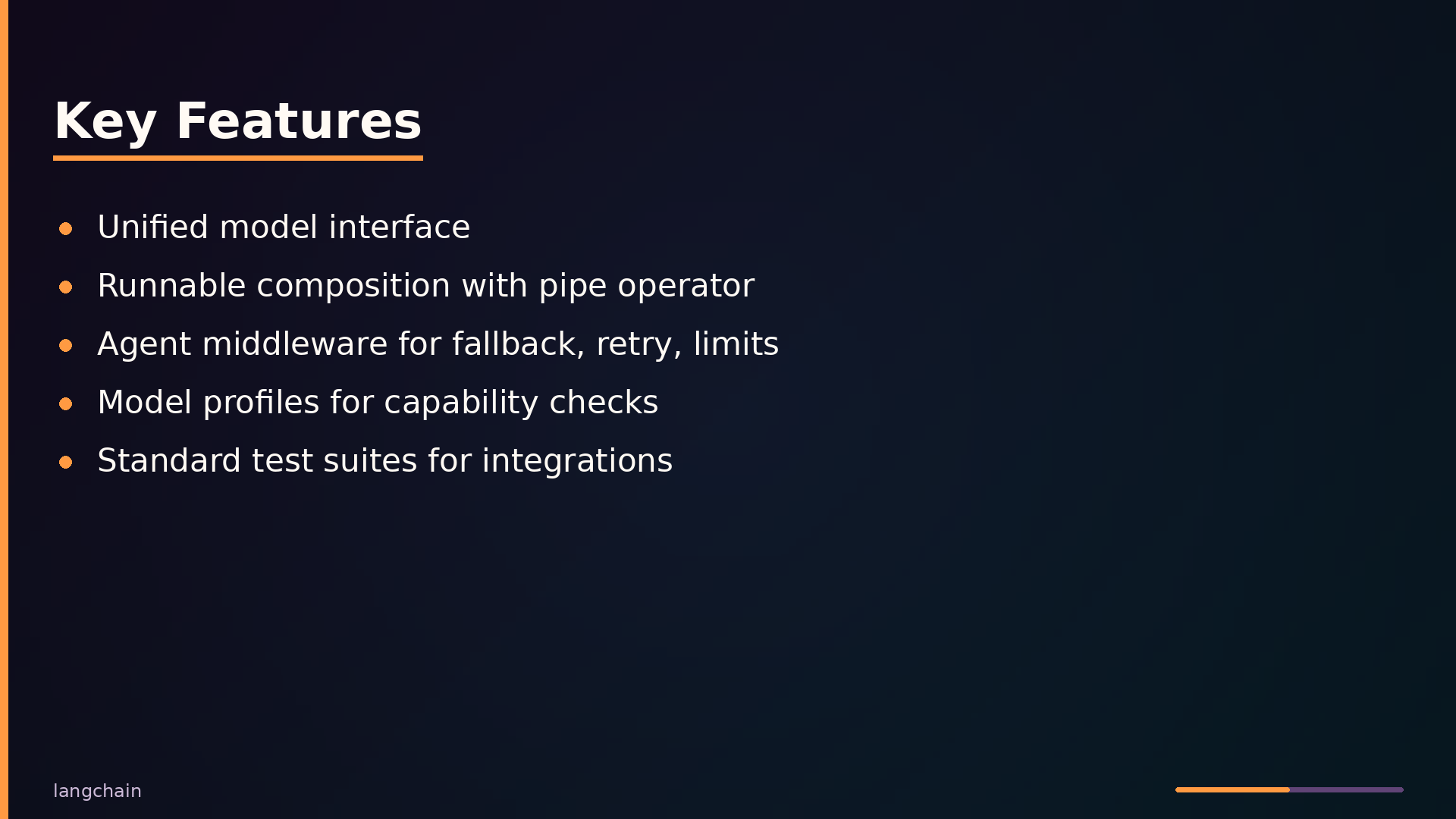
The unified model interface addresses provider fragmentation directly. BaseChatModel and BaseLLM define a common API for chat and completion models, so application code calls model.invoke(...) regardless of whether the underlying provider is OpenAI, Anthropic, or Groq. Swapping providers becomes a one-line change in init_chat_model rather than a rewrite of every call site.
Runnable composition removes the boilerplate of wiring components together manually. Any Runnable can be chained with the | operator, parallelized, or made configurable via configurable_fields. This turns a prompt, model, and output parser into a single pipeline object that supports sync, async, batch, and streaming execution uniformly.
Agent middleware in langchain_v1 keeps cross-cutting concerns out of agent logic. ModelFallbackMiddleware, ModelRetryMiddleware, and ModelCallLimitMiddleware wrap model calls so that fallback, retry with exponential backoff, and call-count enforcement live in composable decorators rather than scattered through agent code. The middleware base class defines hooks like before_model and wrap_model_call, and decorators generate middleware subclasses at runtime.
Model profiles eliminate the need to read provider documentation for capability checks. The langchain-model-profiles CLI generates a Python module from models.dev data, capturing context window, tool-calling support, and other capabilities. Applications can query a model’s profile programmatically instead of hardcoding assumptions that go stale.
Standard test suites enforce integration conformance. Abstract test classes like DocumentIndexerTestSuite live in libs/standard-tests; partner packages subclass them to verify their implementations behave as the framework expects. This catches behavioral drift before it reaches users.
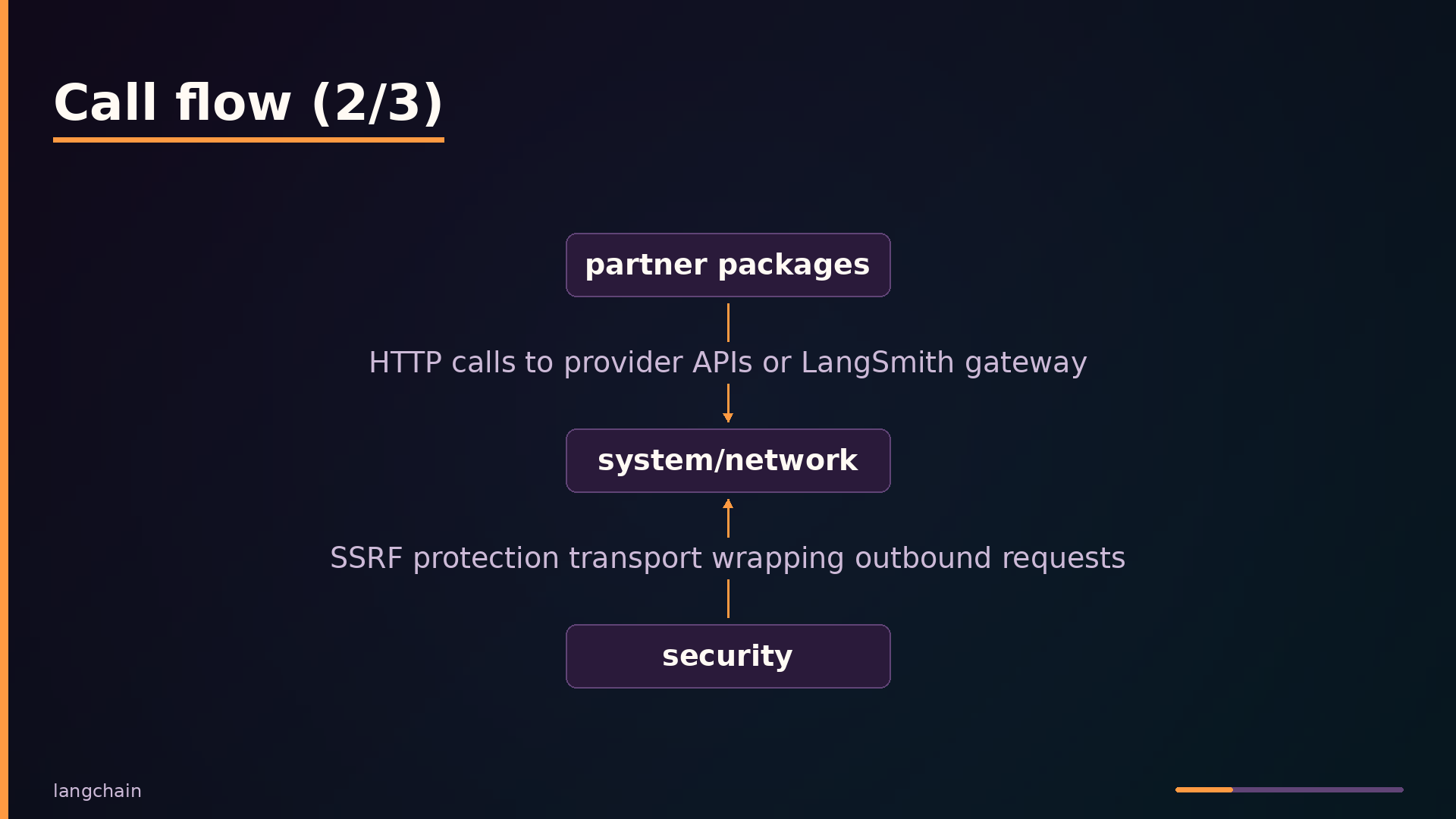
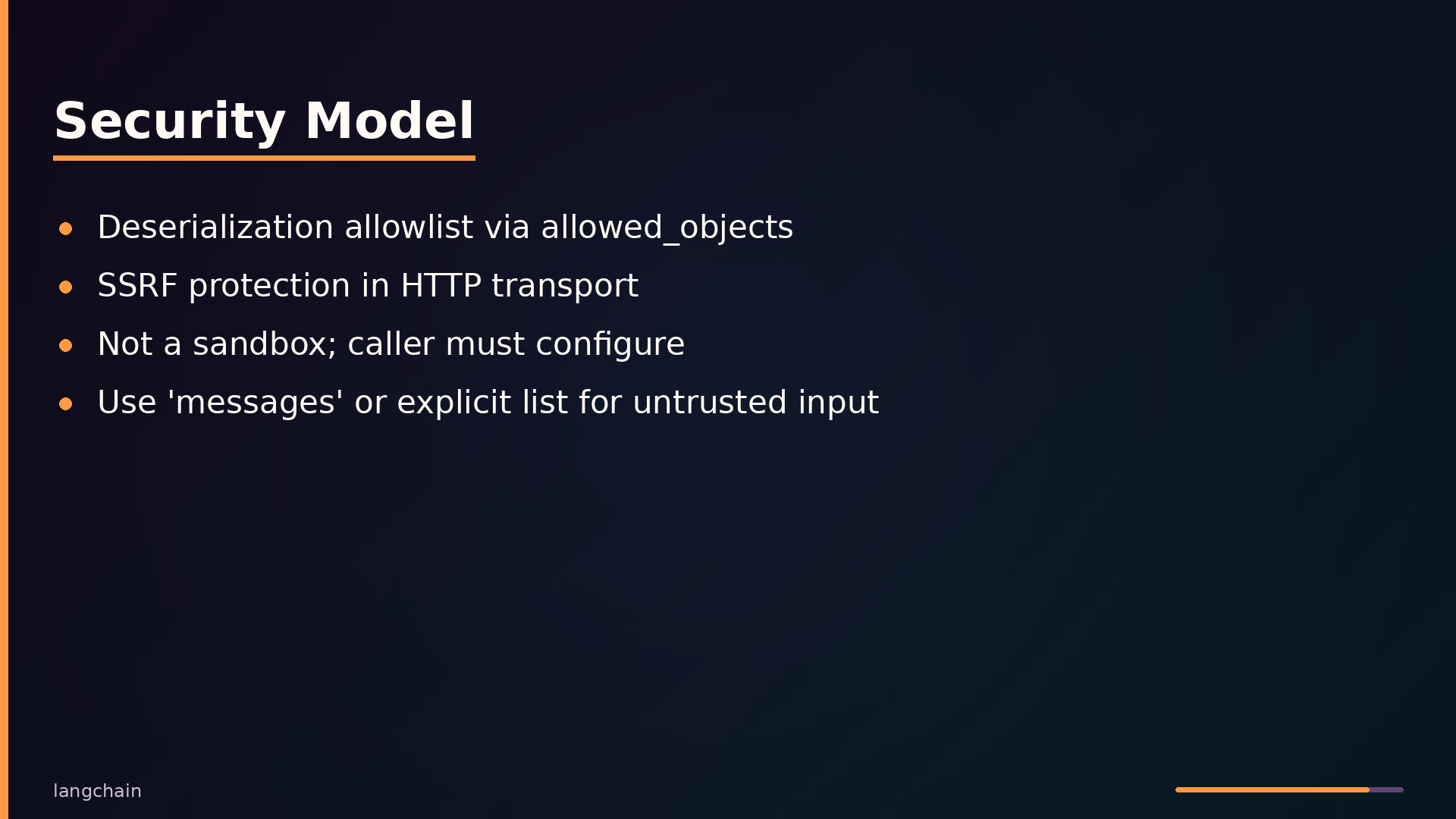
SSRF protection addresses a real attack vector in tools that fetch URLs. SSRFSafeTransport validates the scheme, resolves DNS, checks every resolved IP against policy, and pins to the first valid IP while preserving SNI. This prevents a malicious tool input from redirecting the server to internal addresses.
Security-focused deserialization rounds out the safety story. The load() function checks class paths against an allowed_objects allowlist and blocks Jinja2 templates. The default is restrictive; passing 'core' or 'all' is documented as unsafe for untrusted input, while 'messages' or an explicit list is the recommended posture.
Use Cases: Where It Shines and Where It Struggles
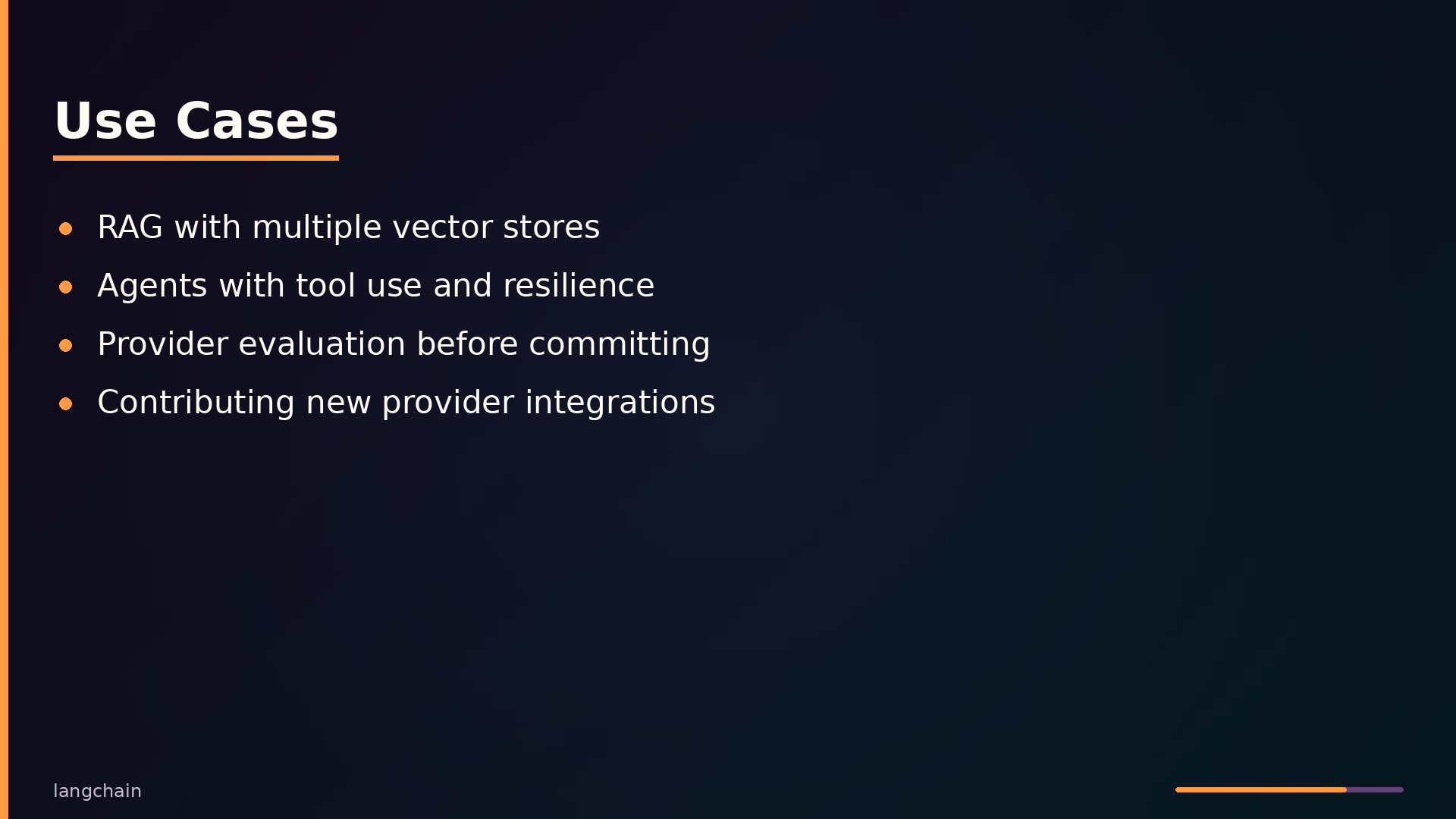
LangChain’s strongest fit is a RAG application that must query multiple vector stores and models. The unified interfaces for embeddings, vector stores, and chat models let you swap components without rewriting application logic. A team that expects to change providers or add a second vector store later will save meaningful rework.
Agent development with tool use is another good fit, particularly when you need resilience. The langchain_v1 middleware stack provides fallback, retry, and call limits as composable wrappers around model calls. You can attach ModelFallbackMiddleware to an agent to try a secondary provider on failure, and ModelRetryMiddleware to apply exponential backoff with jitter, without embedding that logic in the agent itself.
Teams evaluating LLM providers before committing benefit from init_chat_model and the generated model profiles. The string-based model identifiers and capability metadata let you run the same prompt across providers with minimal code changes, which is useful for benchmarking latency, cost, and output quality.
The partial fit is production systems that deserialize untrusted data. LangChain’s load() supports an allowlist via allowed_objects, and the threat model is documented. But the allowlist is not a sandbox; passing allowed_objects='all' or 'core' is unsafe for untrusted input. Teams with strict security requirements must restrict the allowlist to explicit object names and validate inputs before they reach load(). This works, but it places the security burden on the caller.
Contributing a new model provider integration is a well-trodden path. The partner package structure under libs/partners and the shared standard test suites give contributors a clear template and conformance checks, reducing the risk of subtle behavioral drift between providers.
Interface and Usage: Real Code, Explained
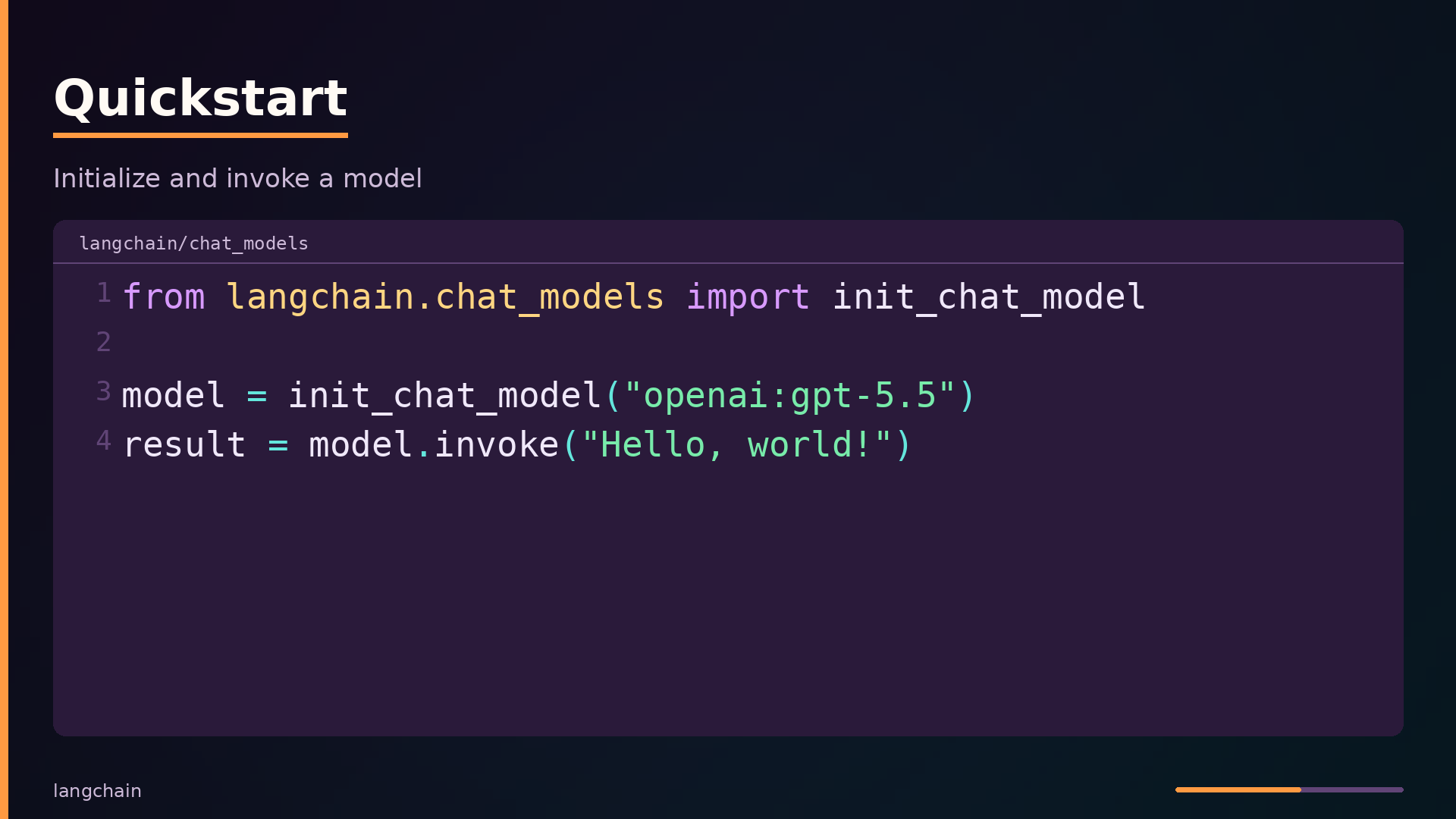
The primary entry points are init_chat_model, create_agent, and the Runnable interface. A minimal invocation requires two lines:
| |
init_chat_model resolves the provider-prefixed string to a BaseChatModel instance. The returned object implements Runnable, so invoke executes synchronously and returns an AIMessage. The same object also supports ainvoke, batch, abatch, and stream.
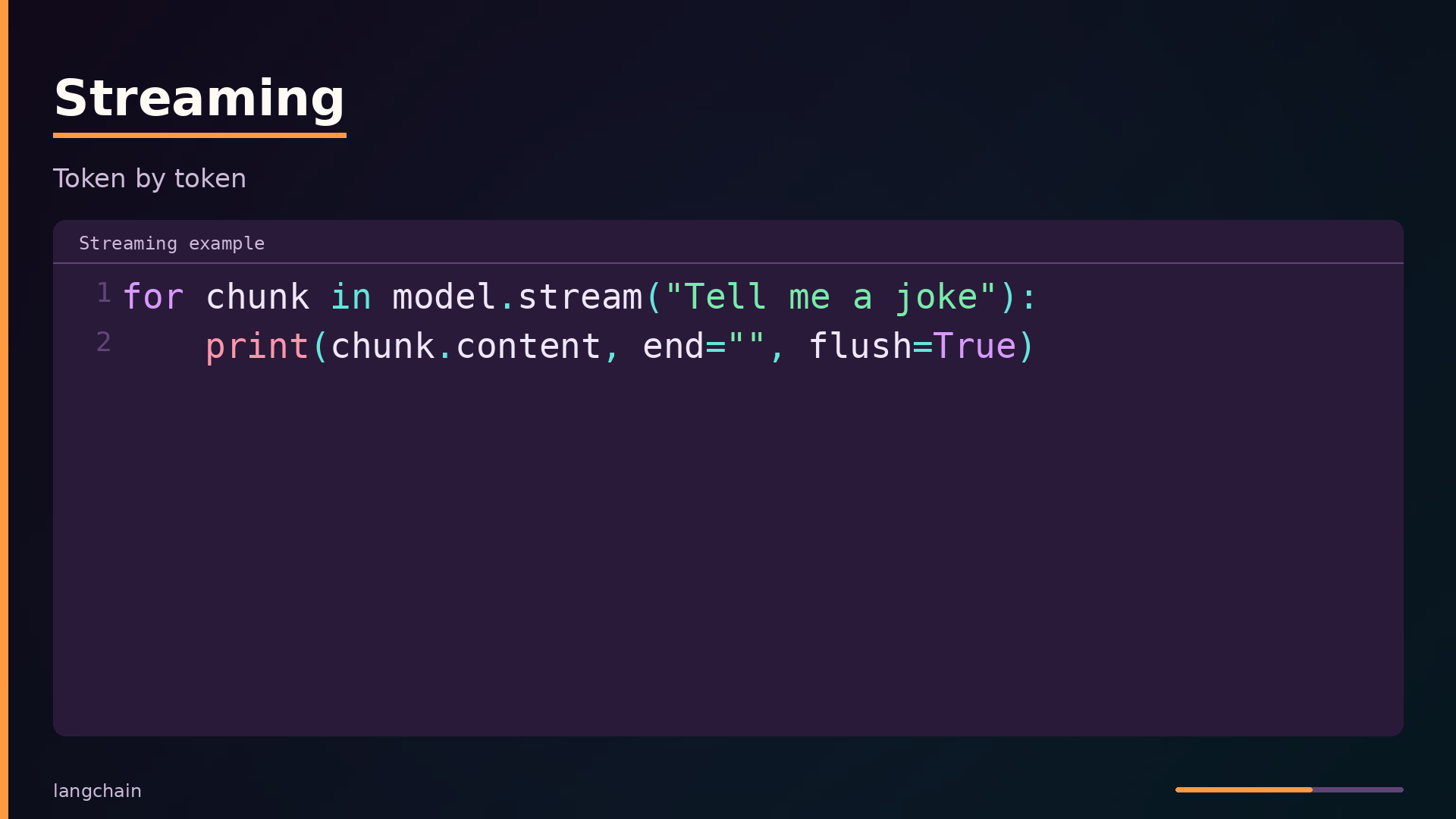
Streaming works through the same interface:
| |
Each chunk is a partial message object; the loop prints content as tokens arrive.
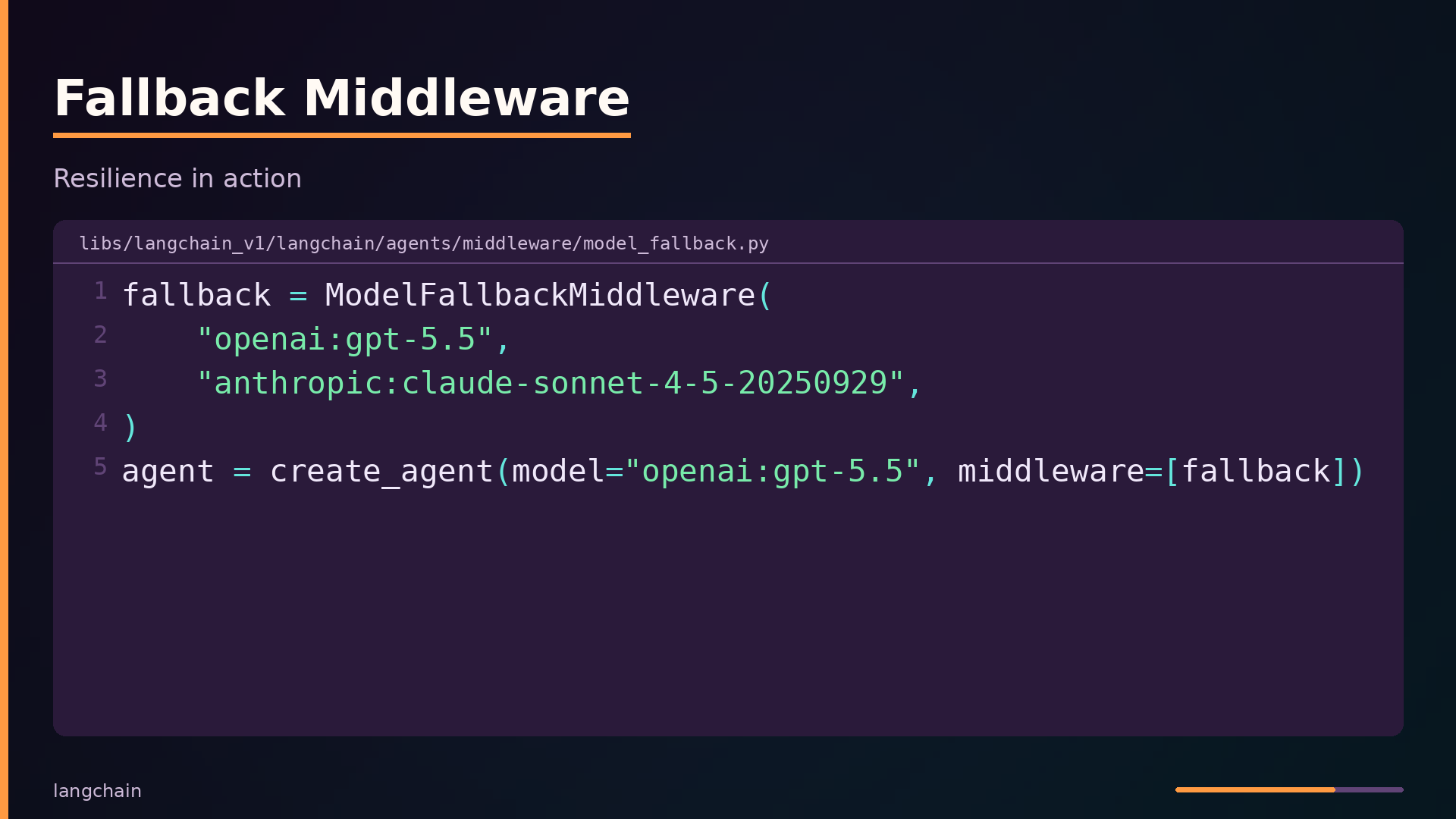
Middleware composes with agents via create_agent. The fallback middleware in libs/langchain_v1/langchain/agents/middleware/model_fallback.py wraps model calls:
| |
The middleware’s wrap_model_call method tries the primary model first, then iterates through fallbacks. A notable detail is the sanitization logic: when the fallback model is not Anthropic-compatible, the middleware strips cache_control markers from the request before retrying:
| |
The _supports_anthropic_cache_control check uses _llm_type rather than model names, so any Anthropic-compatible model keeps its cache markers. The Runnable interface guarantees this middleware works uniformly across sync and async paths because both wrap_model_call and awrap_model_call are defined.
Comparison with Alternatives
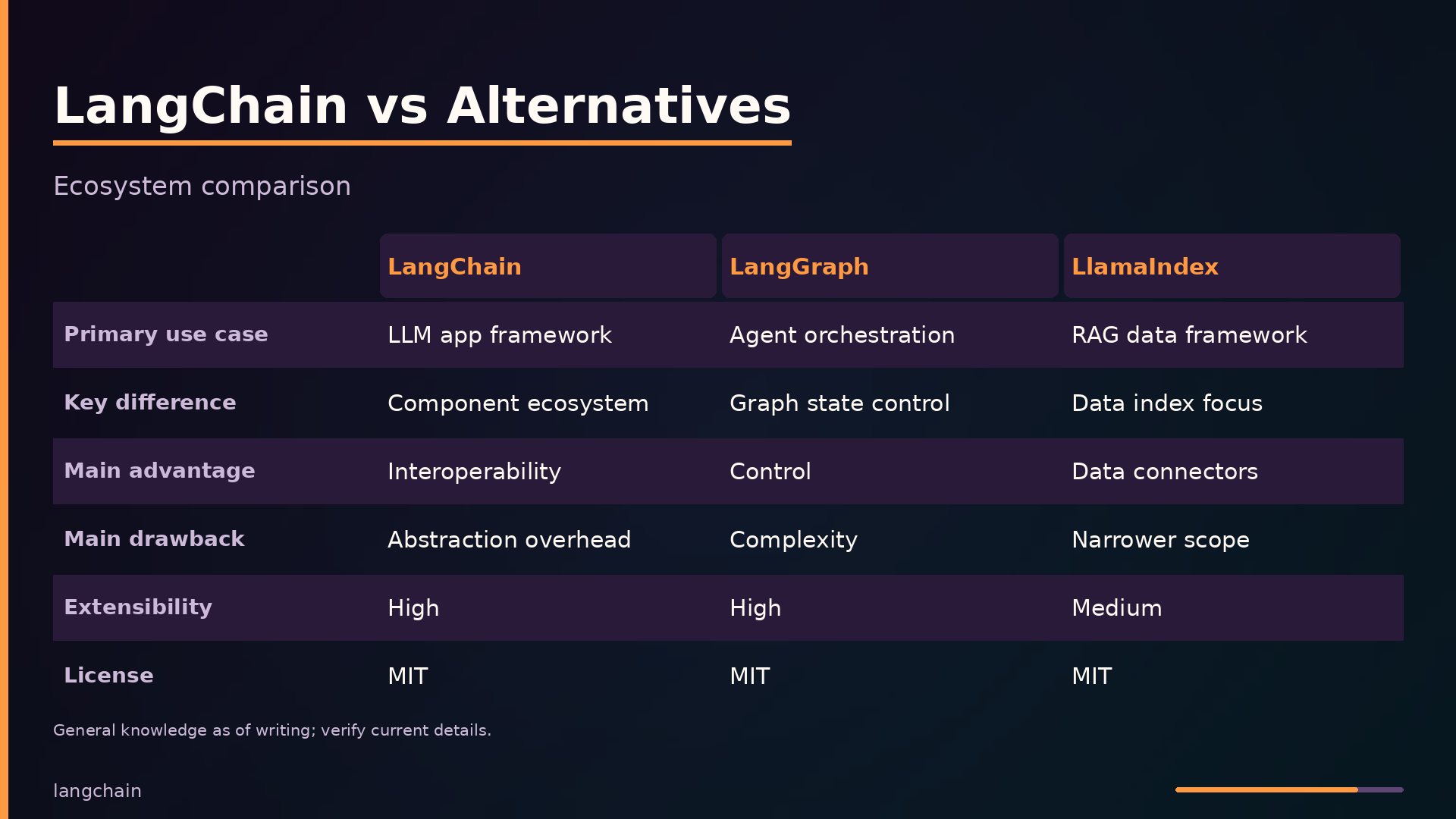
The following comparison reflects general knowledge of the ecosystem as of this writing and may be out of date. Framework capabilities, maturity, and licensing evolve quickly; verify current details before making architectural decisions.
| Axis | LangChain | LangGraph | LlamaIndex | Haystack |
|---|---|---|---|---|
| Primary use case | LLM app framework | Agent orchestration | RAG data framework | Search pipelines |
| Common ground | LLM abstractions | Same ecosystem | LLM abstractions | LLM abstractions |
| Key difference | Component ecosystem | Graph state control | Data index focus | Production pipelines |
| Main advantage | Interoperability | Control | Data connectors | Production-ready |
| Main drawback | Abstraction overhead | Complexity | Narrower scope | Smaller ecosystem |
| Performance | unknown | unknown | unknown | unknown |
| Maturity | active | active | active | active |
| Deployment model | Library | Library | Library | Library |
| Language | Python | Python | Python | Python |
| Extensibility | High | High | Medium | Medium |
| Operational burden | Low | Medium | Low | Medium |
| Licence | MIT | MIT | MIT | Apache-2.0 |
LangGraph is not a competing framework so much as a lower-level sibling. Both come from the LangChain ecosystem and share core abstractions from langchain-core, but LangGraph provides explicit graph-state orchestration for agent loops, while LangChain composes runnables and middleware at a higher level. Teams that need fine-grained control over agent state transitions should reach for LangGraph; teams that want to assemble chains quickly with minimal boilerplate should stay with LangChain.
LlamaIndex concentrates on the data side of RAG: connectors, indices, and retrieval. It shares the LLM abstraction layer with LangChain but offers deeper data-framework capabilities at the cost of a less mature agent story. Haystack targets production search and RAG pipelines with a stronger operational focus, though its integration ecosystem is smaller than LangChain’s.
What to take away
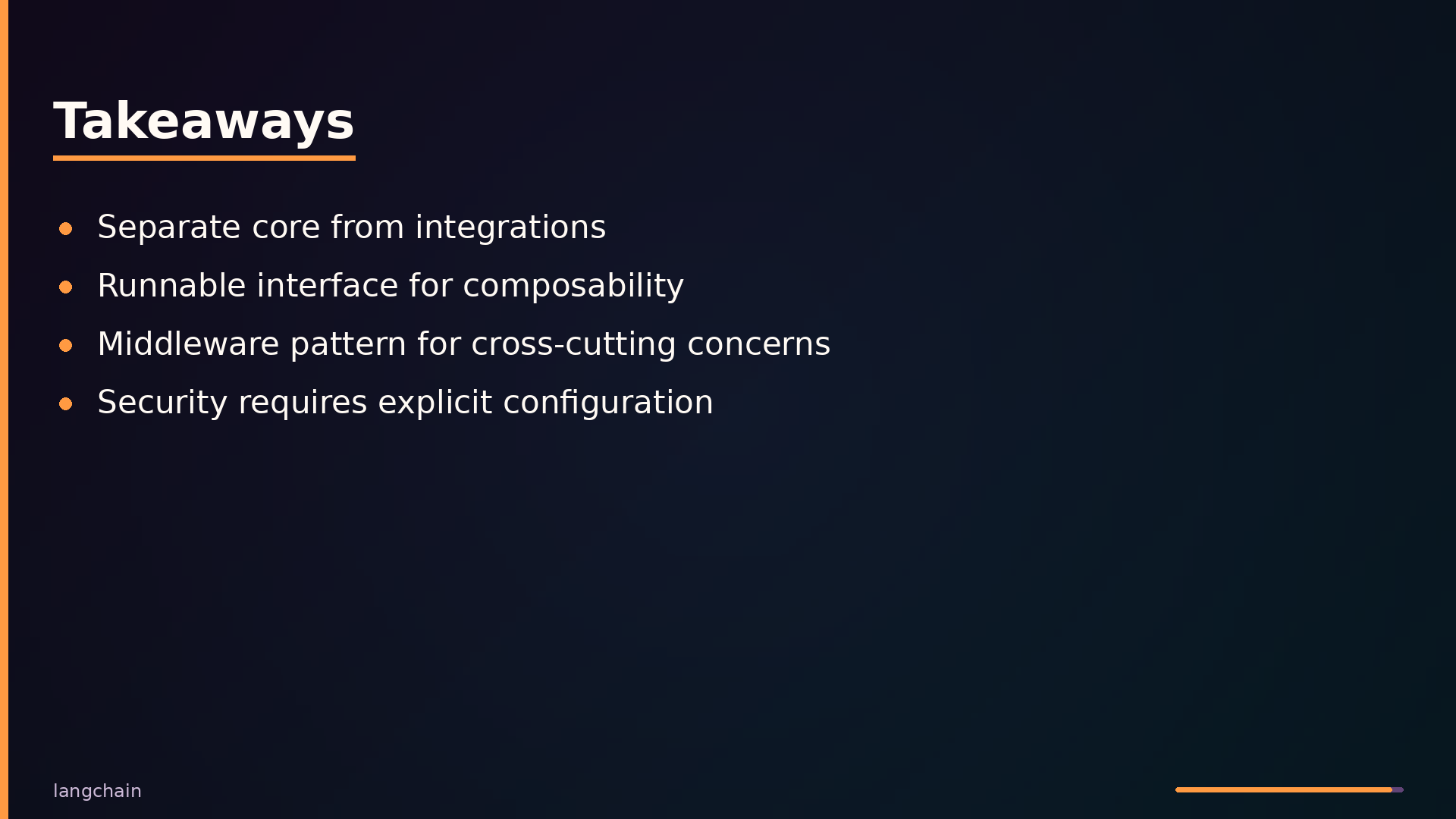
LangChain’s core design decision is the separation of stable abstractions from fast-moving integrations. langchain-core defines the Runnable interface, message types, and tracing machinery, while provider packages live independently and evolve on their own release cadence. That split is worth copying in any framework that must support a large plugin ecosystem: keep the contract small and versioned, and let integrations compete on their own schedule.
The middleware pattern in langchain_v1 is a clean answer to cross-cutting concerns. Fallback, retry, and call-limit logic are implemented as composable wrappers around model calls rather than scattered through agent code. If you build agent systems, this is the pattern to steal.
The security model is honest about its limits. Deserialization uses an allowlist, and the HTTP transport blocks SSRF, but the documentation is explicit that allowed_objects='all' is unsafe for untrusted input. LangChain is not a sandbox; it is a framework with guardrails that require the developer to configure them correctly.
What remains unclear: the migration path from langchain_classic to langchain_v1 is not fully documented, and the _compat_bridge.py module has known fragility with provider streaming formats. Model profiles are generated data and can drift from provider reality.
The source is at github.com/langchain-ai/langchain.
What this analysis could not determine
- Exact performance characteristics of the framework are not measured in the digest.
- The full list of partner packages and their specific features is not exhaustively documented in the digest.
- The relationship between
langchain_v1andlangchain_classicin terms of migration path is not fully clear. - The exact behavior of the
_compat_bridge.pyfor all provider streaming formats is not fully verified.
Further diagrams