How CrewAI’s dual abstractions—Crews and Flows—balance agent autonomy with workflow control, and what that means for production systems.
Building a multi-agent system that is both flexible and reliable is a constant tug-of-war. Too much autonomy and your agents wander off-task; too much control and you lose the benefits of collaboration. CrewAI is a Python framework that tries to resolve this by offering two complementary abstractions: role-based Crews for autonomous collaboration and event-driven Flows for deterministic control.
The repository is an active, multi-package Python workspace at version 1.15.x. It is not a toy: the core library alone spans agent execution, MCP transport, A2A protocol support, checkpointing, and RAG clients, with a CLI that scaffolds projects, runs crews, and manages deployment. The codebase is large and moving fast, with high commit velocity and frequent releases.
By the end of this article, you will understand how Crews and Flows work under the hood, where each abstraction fits, and where the framework’s design decisions—such as JSON-first project scaffolding and a unified runtime state—help or hurt in production. You will also see where the framework’s maturity shows and where it may still trip you up.
What CrewAI Is (and Isn’t)
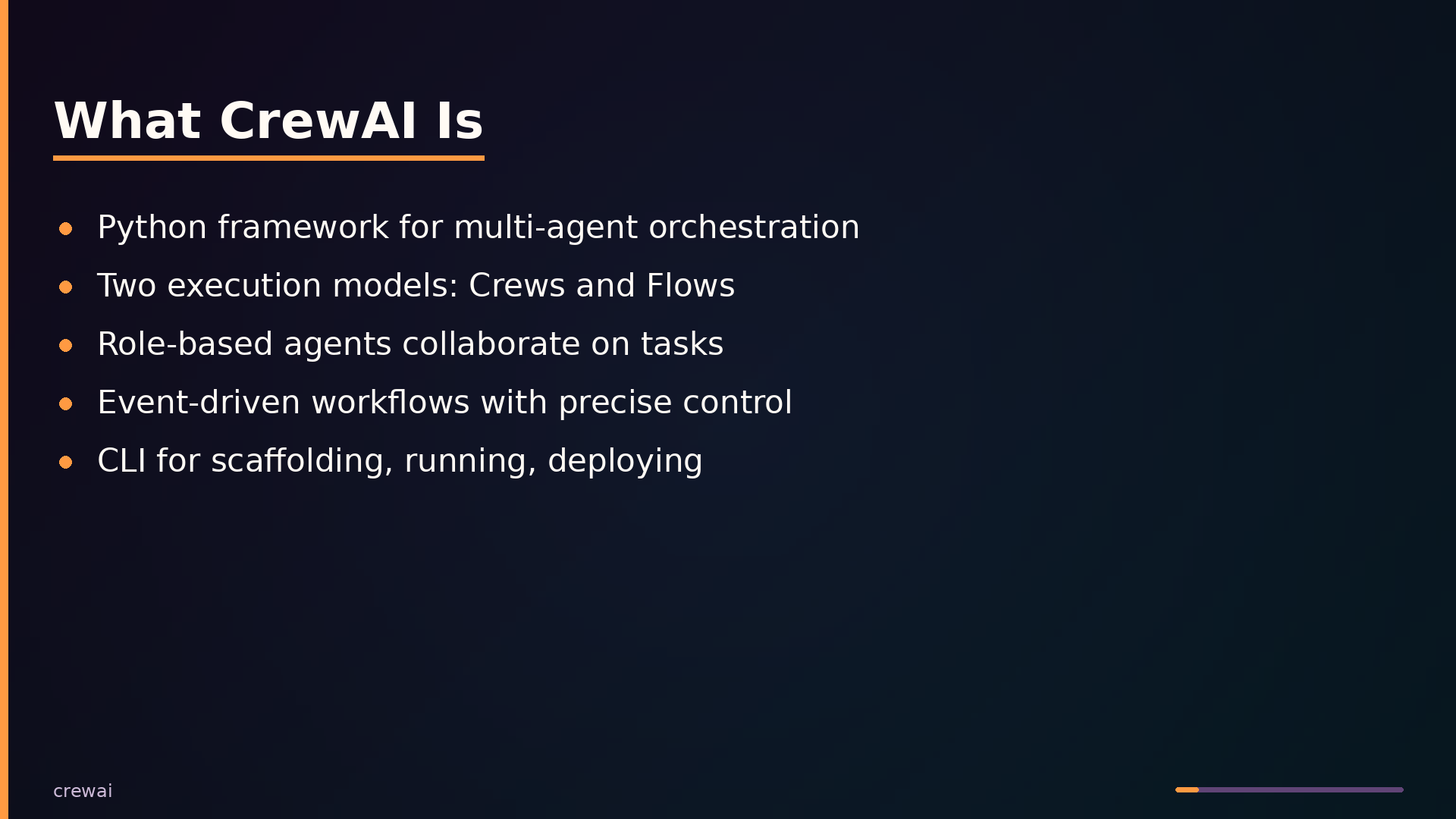
CrewAI is a Python framework for orchestrating multi-agent AI systems. It exposes two complementary execution models: Crews, where role-based agents collaborate autonomously on tasks, and Flows, which are event-driven, stateful workflows with deterministic control. The core library provides Agent, Task, Crew, and Flow primitives, with an event bus for telemetry and observability.
CrewAI is not a single-agent LLM library like LangChain’s basic chains, nor a low-level agent runtime like AutoGen’s raw agents. It is also not a hosted platform itself, though it integrates with the commercial CrewAI AMP suite for deployment and governance.
In the stack, CrewAI sits above LLM providers via LiteLLM and below application-specific logic. It provides the orchestration layer that connects LLMs, tools, and external protocols—MCP for tool discovery and A2A for agent-to-agent communication—into cohesive agent systems. The CLI and Plus API connect the open-source framework to the CrewAI cloud control plane.
The project is organized as a multi-package Python workspace: crewai (core library), crewai-cli (command-line tooling), crewai-core (shared primitives), crewai-tools (tool integrations), crewai-files (file handling), and devtools. Development is active, with high commit velocity, frequent releases in the 1.15.x series, and a large contributor base.
Architecture: From CLI to Checkpoint
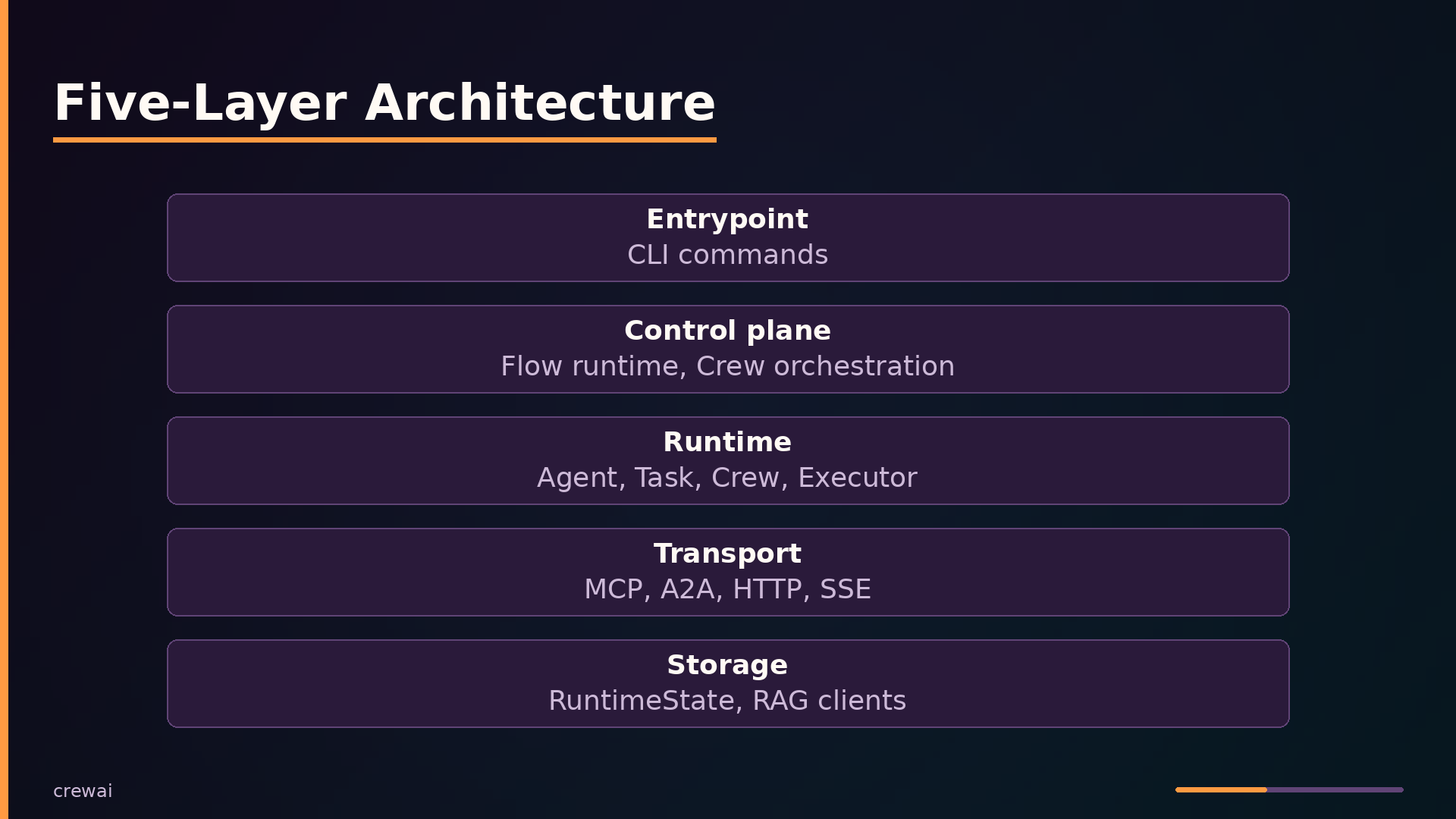
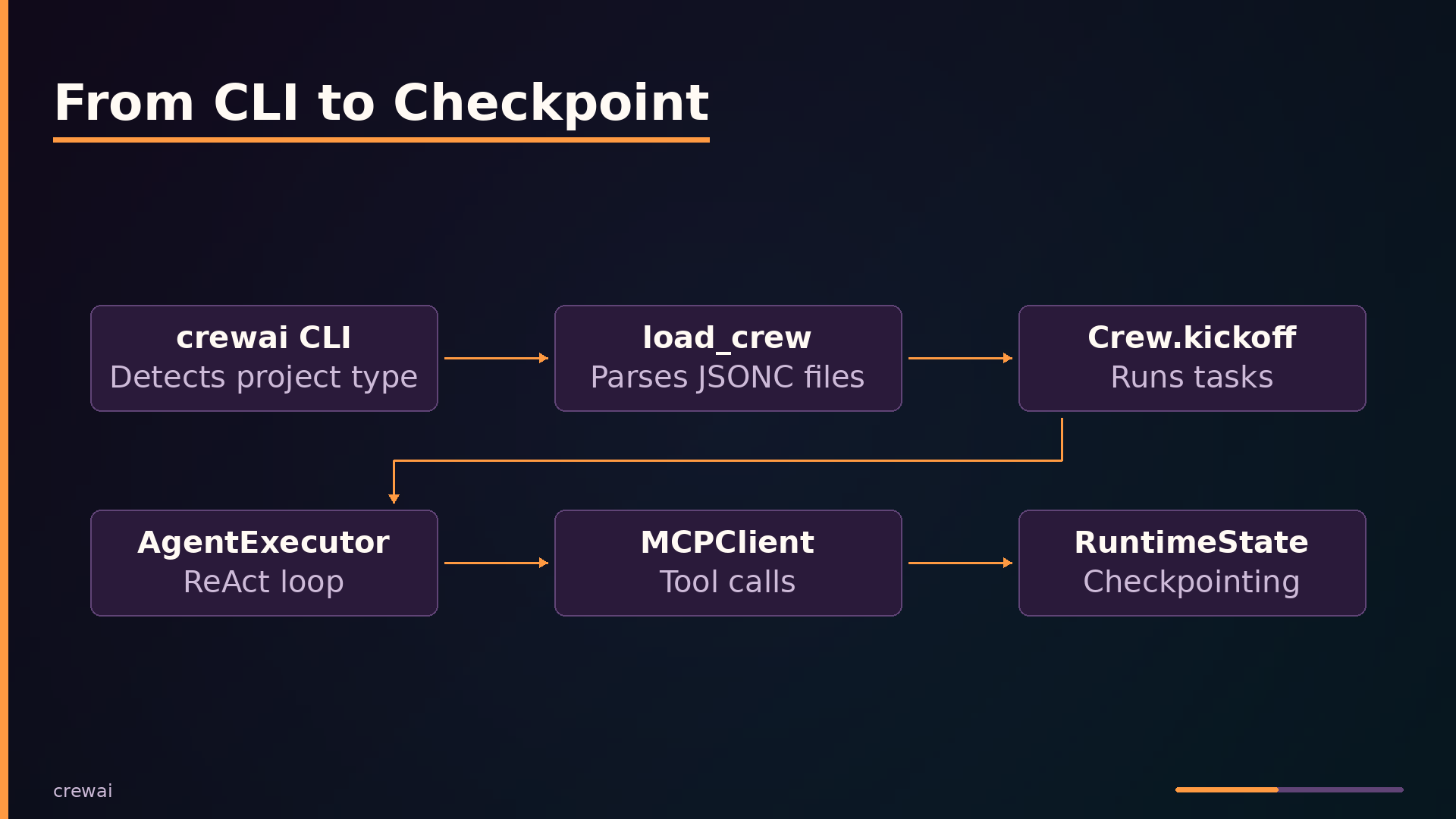
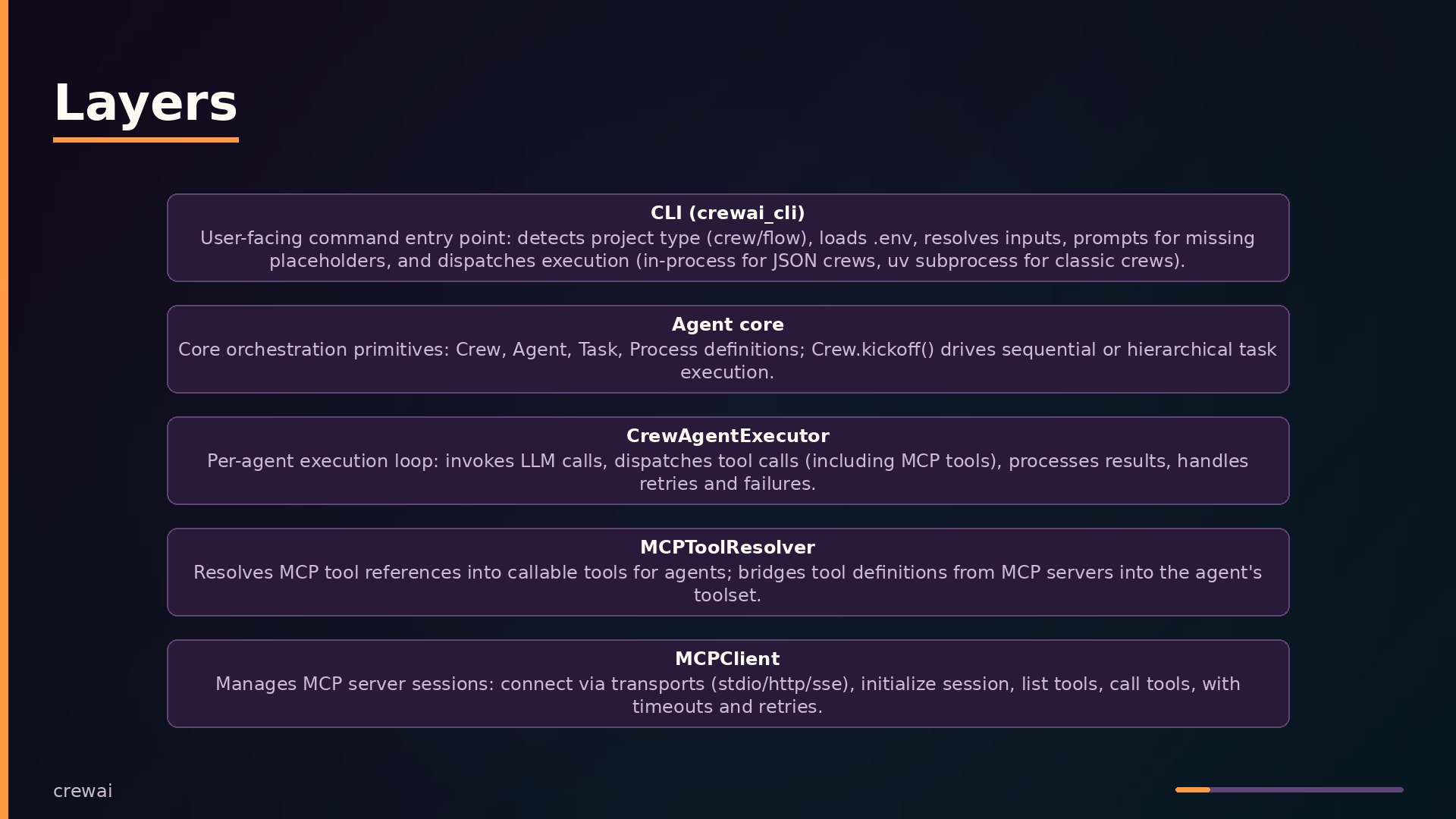
CrewAI’s architecture is a five-layer stack: entrypoint, control plane, runtime, transport, and storage. The entrypoint is the crewai CLI, which parses user commands, detects the project type from pyproject.toml, and dispatches execution. The control plane holds the Flow runtime and Crew orchestration logic, determining execution order and resolving inputs. The runtime layer contains the core primitives—Agent, Task, Crew, and AgentExecutor—that execute LLM calls and tool invocations. Transport handles protocol-level communication via MCP and A2A, while storage persists state through RuntimeState and RAG clients.
| |
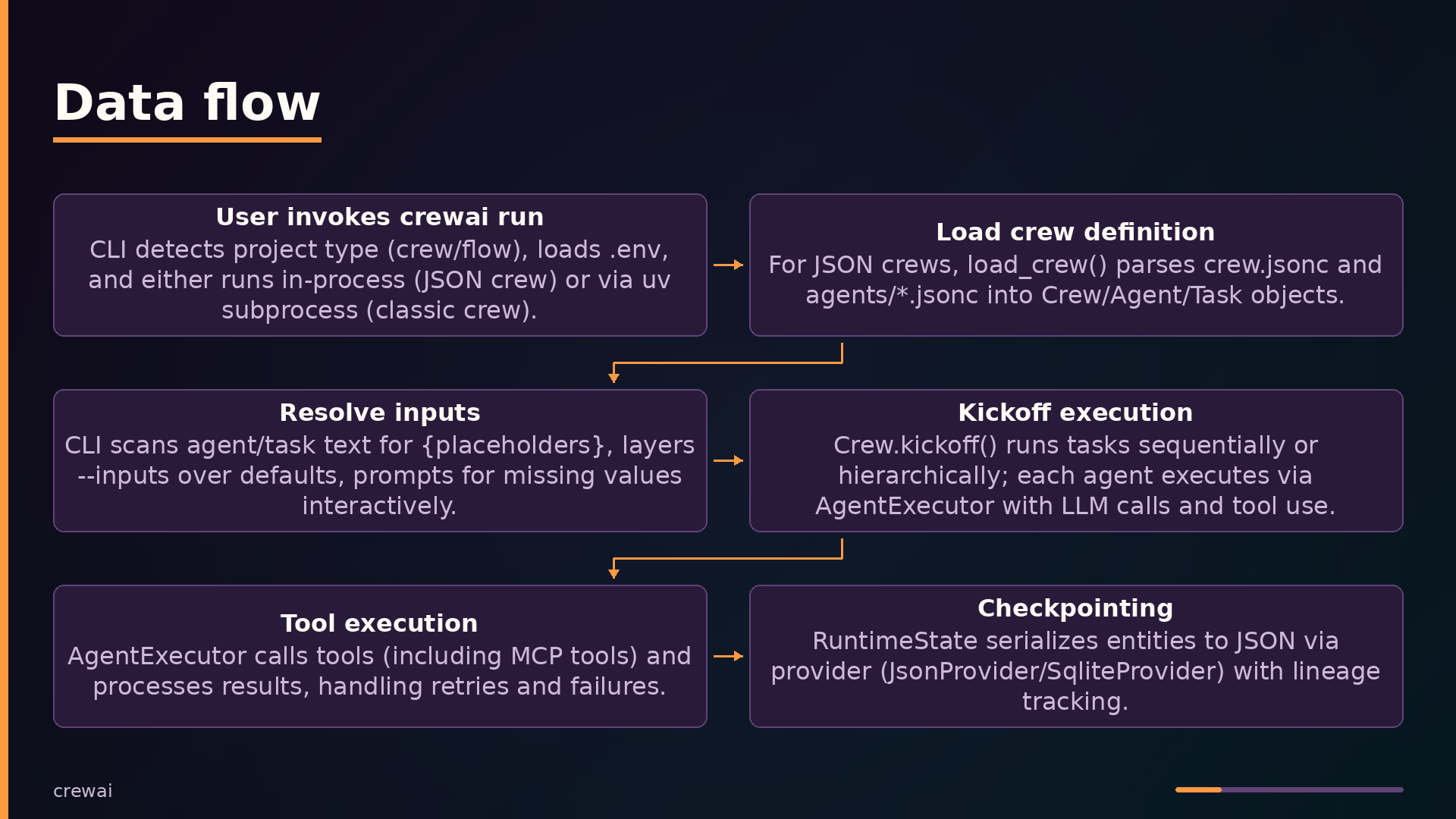
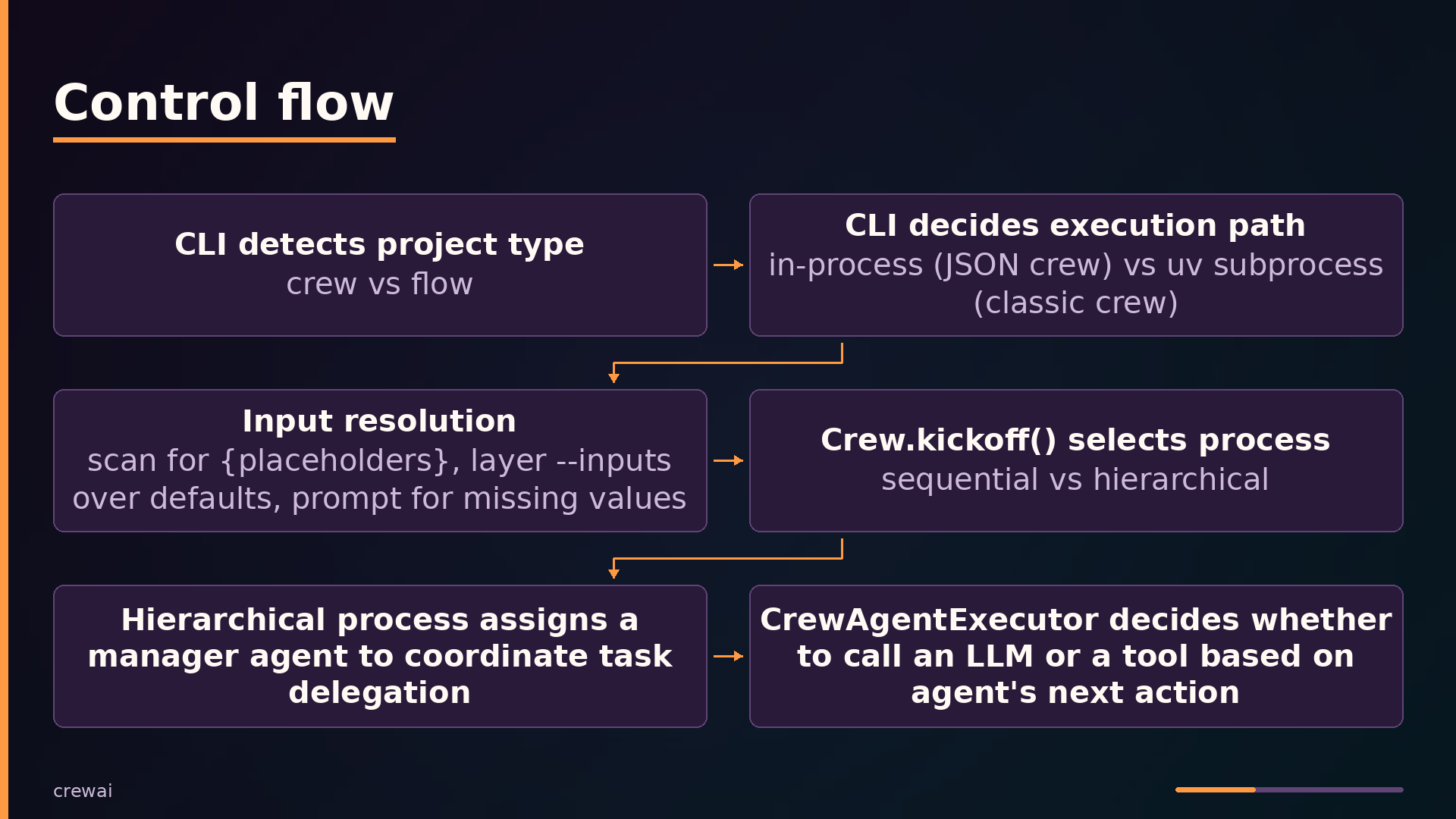
The data flow begins when a user invokes crewai run. The CLI reads pyproject.toml to determine whether the project is a crew or flow. For JSON-defined crews, load_crew() parses crew.jsonc and agents/*.jsonc into Crew/Agent/Task objects in-process. Classic Python crews run via a uv subprocess, isolating project dependencies. Input resolution scans agent and task text for {placeholder} patterns, layers --inputs over declared defaults, and prompts interactively for missing values.
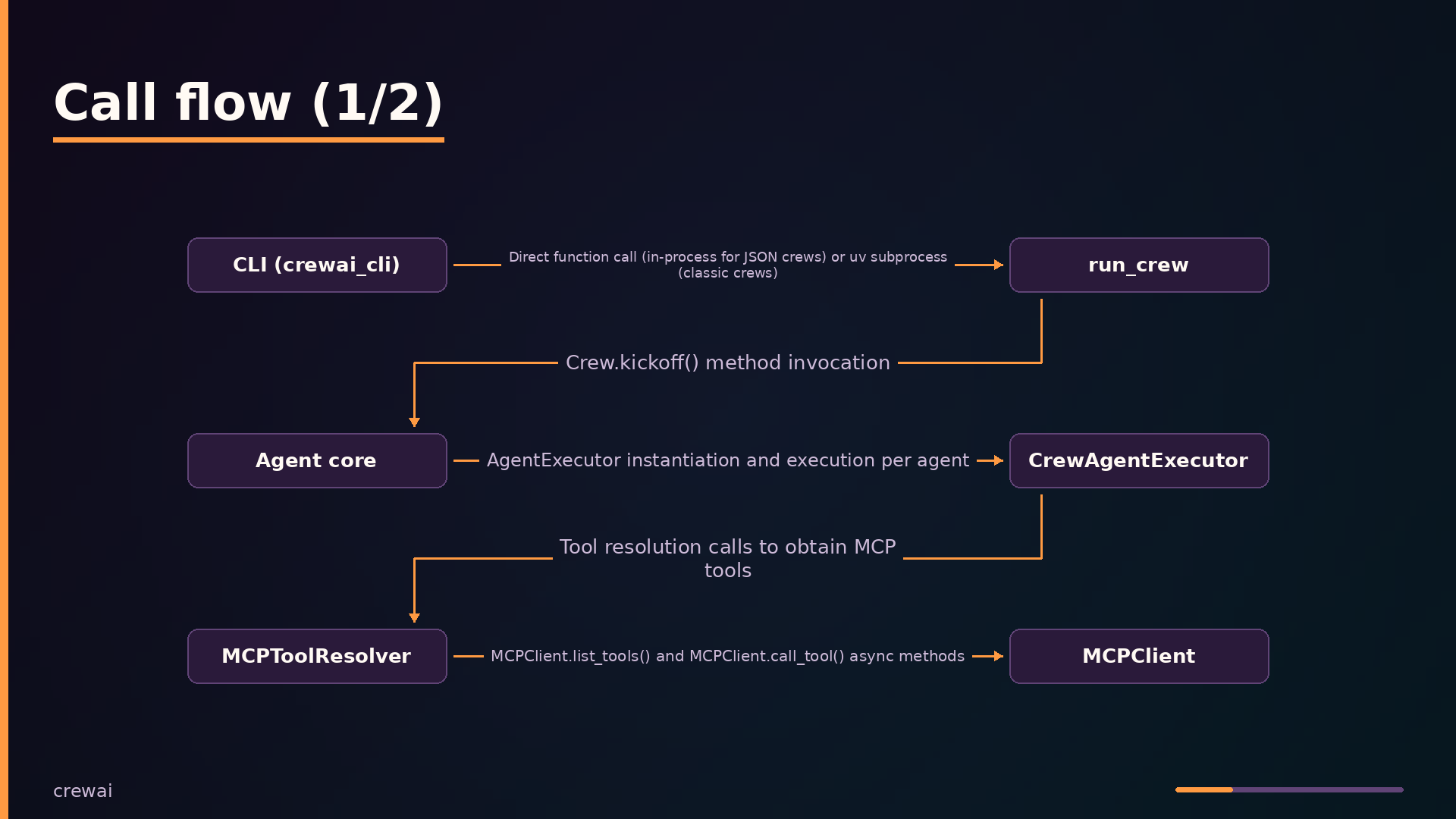
Execution proceeds through Crew.kickoff(), which runs tasks sequentially or hierarchically. Each agent’s kickoff() delegates to an AgentExecutor that drives the ReAct loop: LLM calls, tool invocations, and result processing. Tool calls route through MCPToolResolver into MCPClient, which manages sessions over stdio, HTTP, or SSE transports with retry and exponential backoff. Throughout execution, RuntimeState.checkpoint() serializes all active entities to JSON via a provider, enabling resumable runs and lineage tracking.
The event bus is a central typed pub/sub mechanism. Components emit lifecycle events—agent started/completed, MCP connection status, checkpoint writes—that listeners consume for telemetry and tracing. Control-flow decisions happen at several points: project type detection, input resolution strategy (heuristic placeholder scan for crews vs. authoritative state schema for flows), and interactive vs. headless mode selection based on terminal detection and CREWAI_DMN mode.
Key Features: What Problems They Solve
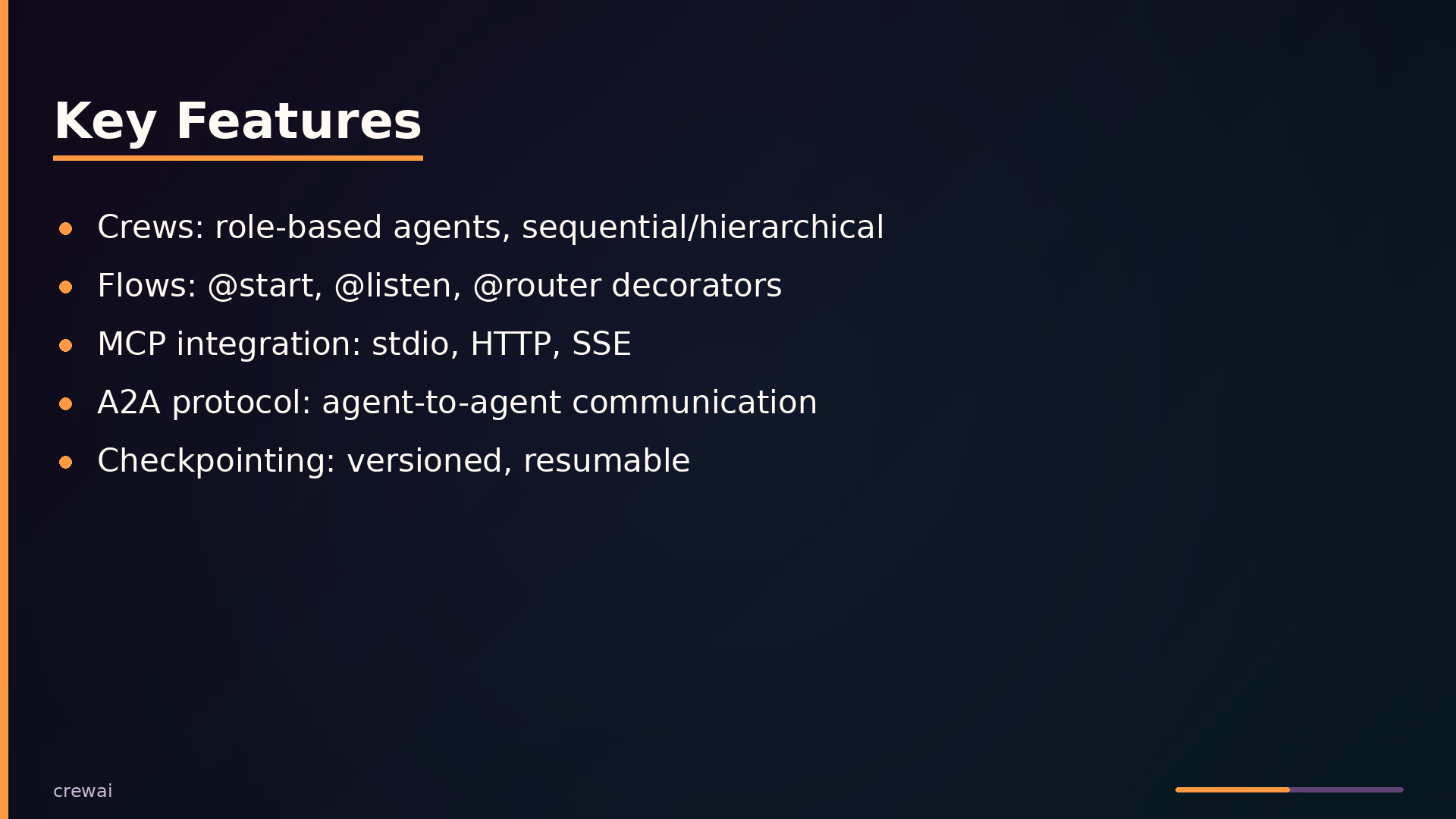
CrewAI’s core abstraction is the Crew: role-based agents with defined goals, backstories, and tools, orchestrated in sequential or hierarchical processes. The Agent class in lib/crewai/src/crewai/agent/core.py encapsulates the collaborative intelligence pattern, so developers define what each agent does rather than managing the underlying ReAct loop, message history, and tool dispatch themselves. This removes the boilerplate of hand-writing agent coordination loops.
Event-driven Flows, implemented in lib/crewai/src/crewai/flow/flow.py, address the opposite problem: deterministic control. Where Crews delegate execution order to the agents, Flows use @start, @listen, and @router decorators with typed pydantic state to make every execution path explicit. This solves the pain point of unpredictable multi-agent runs by giving developers precise control over branching, state transitions, and conditional logic.
MCP integration in lib/crewai/src/crewai/mcp/ standardizes tool connectivity. Instead of writing bespoke adapters for each external API, the MCPClient and MCPToolResolver handle stdio, HTTP, and SSE transports, session management, and retries. This removes the fragmentation problem where every tool vendor exposes a different interface; one protocol covers them all.
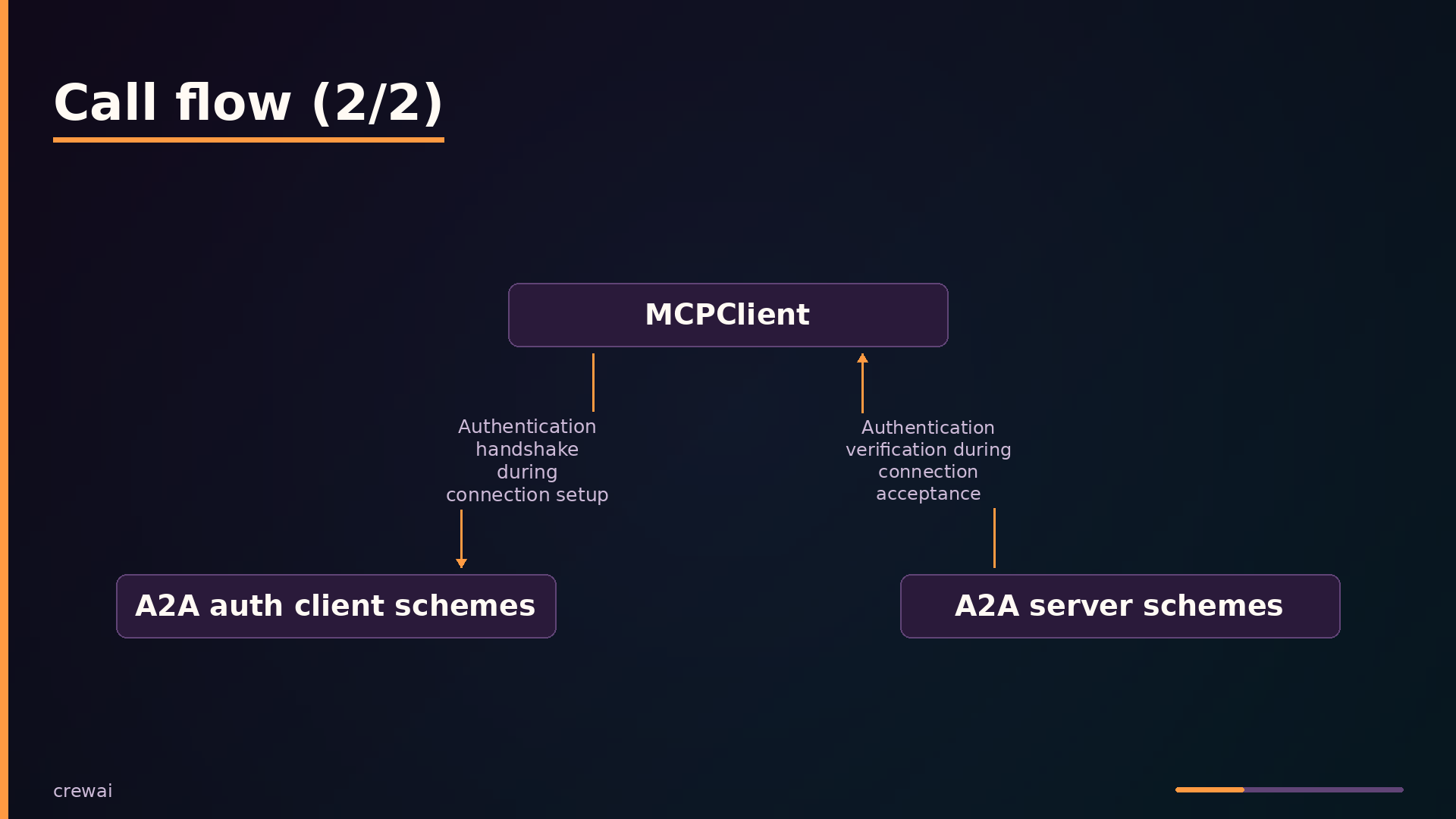
A2A protocol support in lib/crewai/src/crewai/a2a/ enables agent-to-agent communication with client and server authentication schemes (bearer, OAuth2, mTLS, OIDC). This solves agent isolation: a CrewAI agent can delegate to remote agents running elsewhere, and extensions like A2UI allow agents to generate dynamic UI surfaces.
Checkpointing via RuntimeState in lib/crewai/src/crewai/state/runtime.py serializes all active entities to JSON with versioned migrations and lineage tracking. Long-running workflows survive process failures and can resume from the last checkpoint, while the audit trail satisfies governance requirements.
Finally, the CLI in lib/cli/src/crewai_cli/ provides scaffolding, running, training, and deployment commands. The crewai create crew and crewai run workflow removes the friction of project setup and gives teams a consistent path from blank directory to production deployment.
Use Cases: Where It Fits (and Where It Doesn’t)
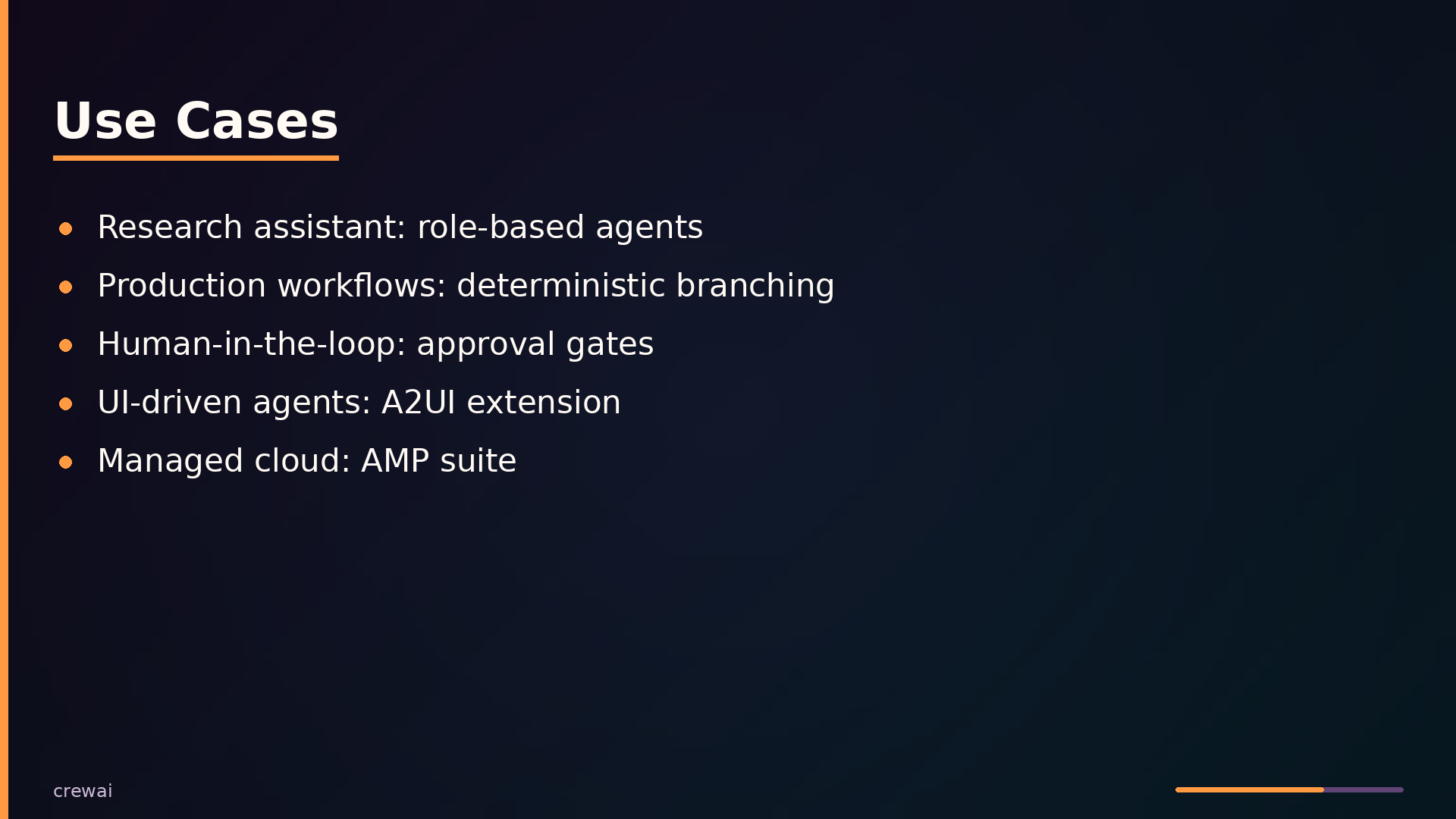
CrewAI’s strongest fit is the role-based research assistant pattern. A crew of agents with distinct roles—researcher, analyst, writer—running in a sequential process maps directly onto the framework’s core abstraction. Each agent carries its own goal, backstory, and tools, and the sequential process guarantees task ordering without manual orchestration code.
Production workflows requiring deterministic branching and human oversight are equally well served by Flows. The event-driven decorators (@start, @listen, @router) give precise control over execution paths, while typed state schemas and checkpointing provide resumability. Human-in-the-loop checkpoints via @human_feedback integrate directly into the flow runtime, making approval gates a first-class concept rather than a workaround.
Several scenarios are only partially covered. Exposing an agent as a UI-driven application through the A2UI extension works, but this is a newer feature with less maturity than the core crew and flow abstractions. Similarly, deploying many agent workflows to a managed cloud requires the commercial AMP suite; the open-source framework alone provides the CLI and local execution but not hosted observability or governance. The experimental evaluation module supports dataset-driven comparison of agent configurations, but it is not yet a fully mature experimentation platform.
A poor fit is a purely data-centric RAG pipeline. LlamaIndex offers stronger retrieval abstractions, data connectors, and query engines for that workload. Likewise, if you need free-form conversational agents that negotiate and improvise, AutoGen’s conversational model is more appropriate than CrewAI’s task-oriented crews.
CrewAI is not a one-size-fits-all solution. It is designed for structured multi-agent orchestration where role separation and deterministic control matter more than open-ended conversation or data plumbing.
Interface and Usage: Code That Works
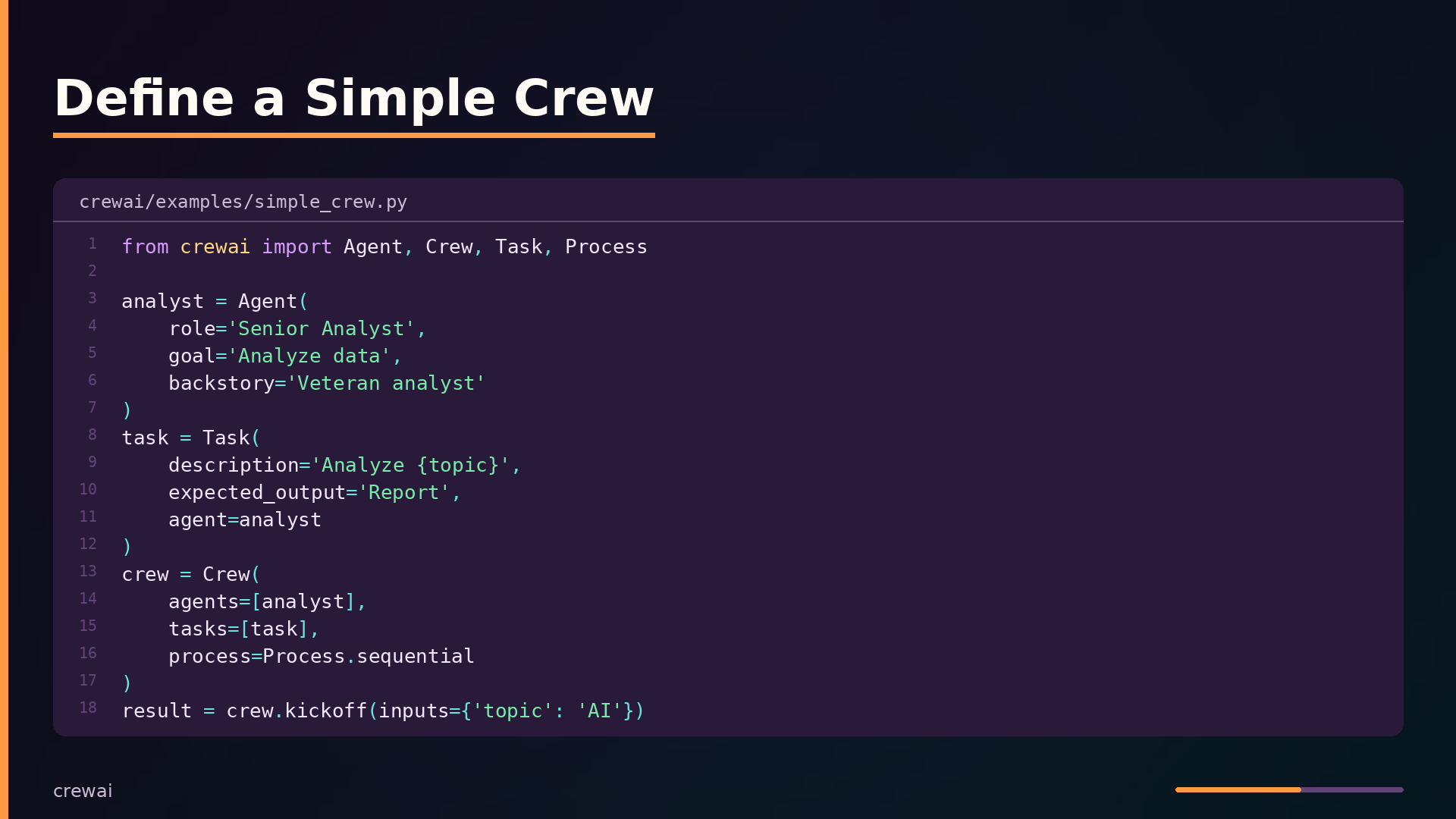
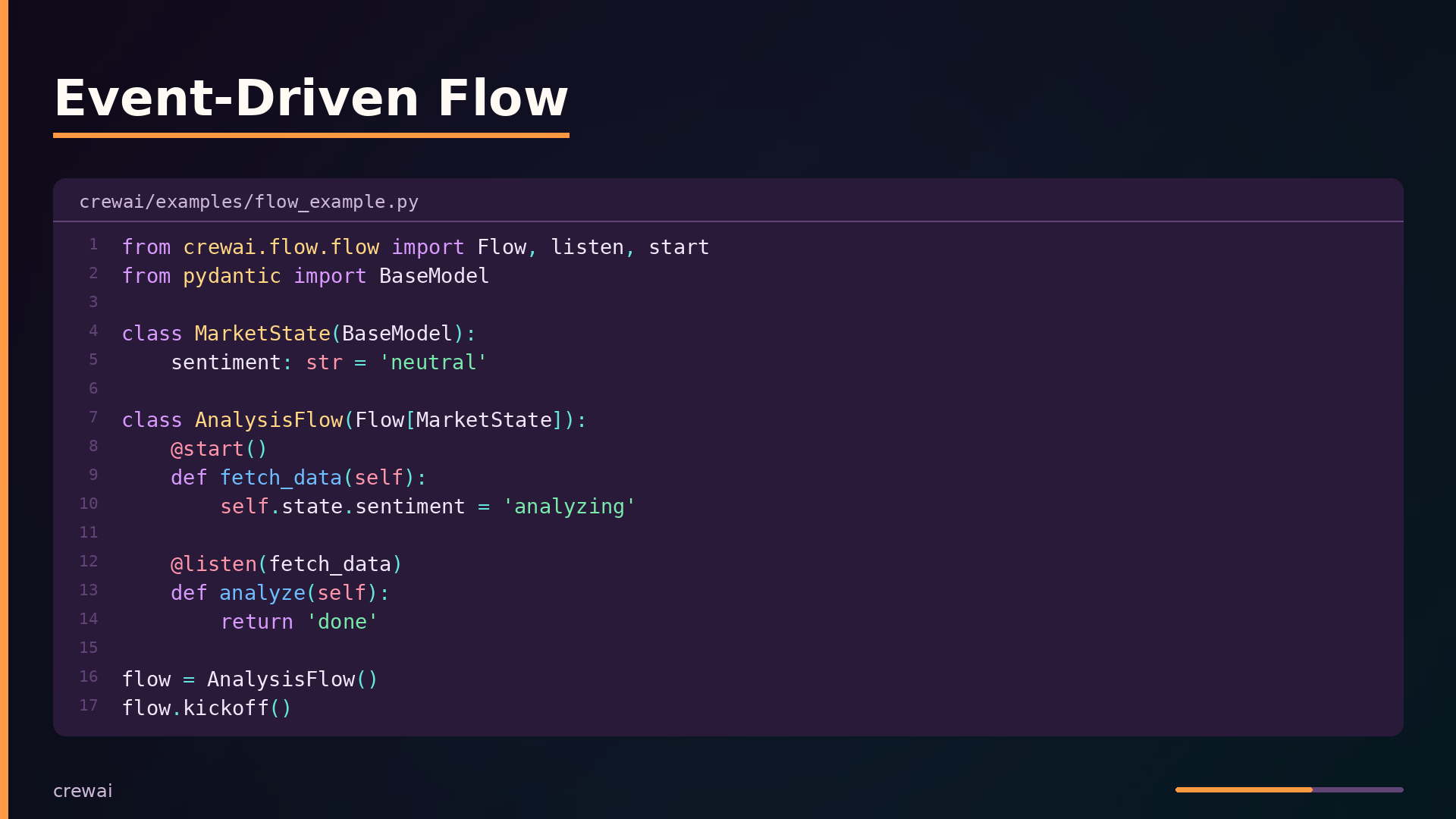
The Python API surface is compact: Agent, Task, Crew, and Process for crew-based orchestration, plus Flow, start, and listen for event-driven workflows. A minimal crew definition looks like this:
| |
The {topic} placeholder in the task description is resolved at kickoff time from the inputs dict. Process.sequential executes tasks in order; the alternative is a hierarchical process where a manager agent delegates work.
Flows provide deterministic control with typed state. The Flow class is generic over a Pydantic state model:
| |
The @start decorator marks the entry point; @listen(fetch_data) chains the next method to run after fetch_data completes. State mutations persist on self.state and are available to downstream listeners.
The CLI mirrors these two execution models. crewai create crew my_project scaffolds a project, crewai run executes it, crewai flow plot visualizes flow topology, and crewai deploy handles deployment. JSON projects use agents/*.jsonc and crew.jsonc configuration files; the --classic flag generates the older Python/YAML layout.
One gotcha: CrewAgentExecutor is deprecated. Agents now use AgentExecutor by default, which may alter execution behavior for code that relied on the old executor’s specifics.
How It Compares: CrewAI vs. LangChain, AutoGen, LlamaIndex
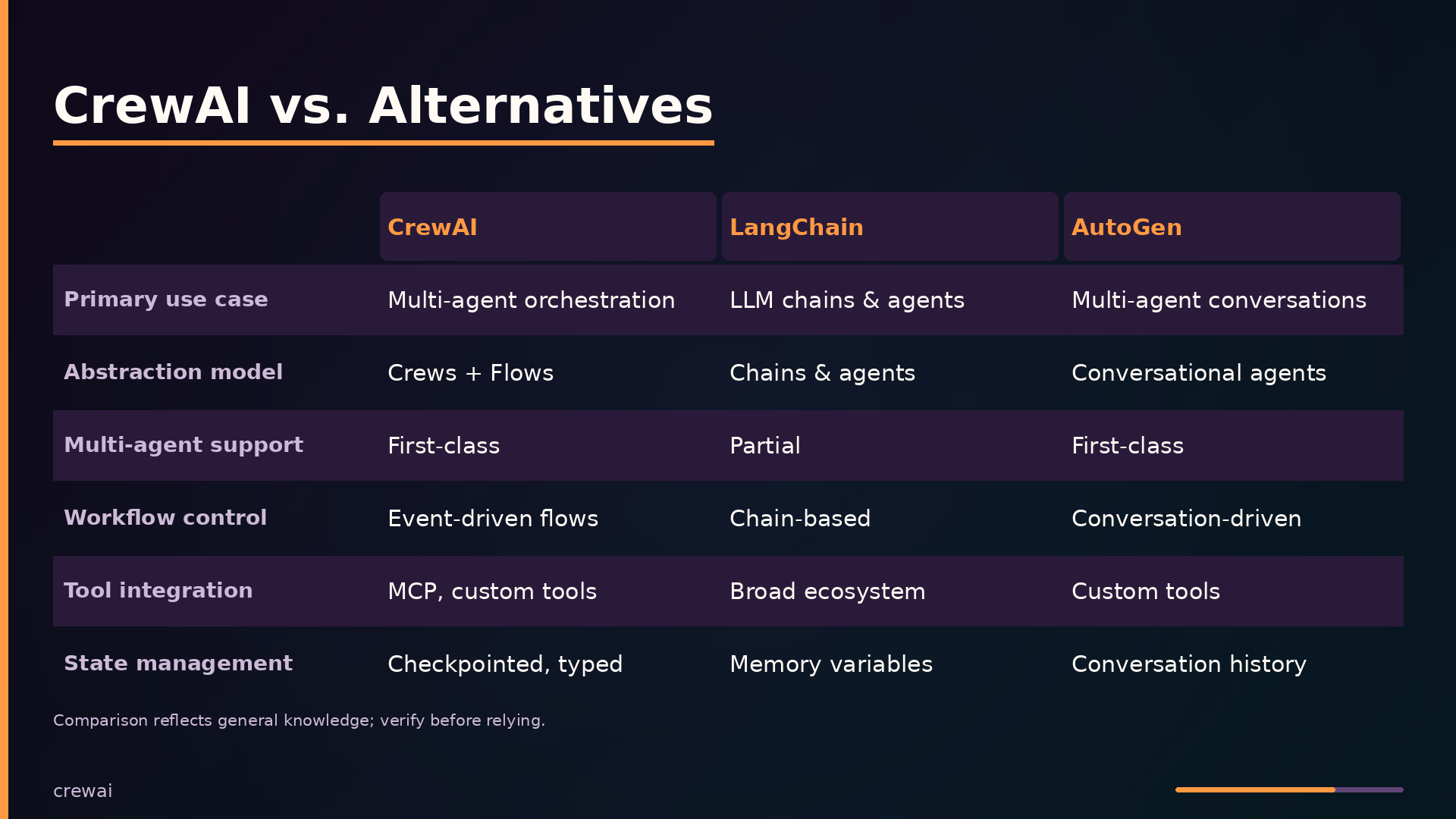
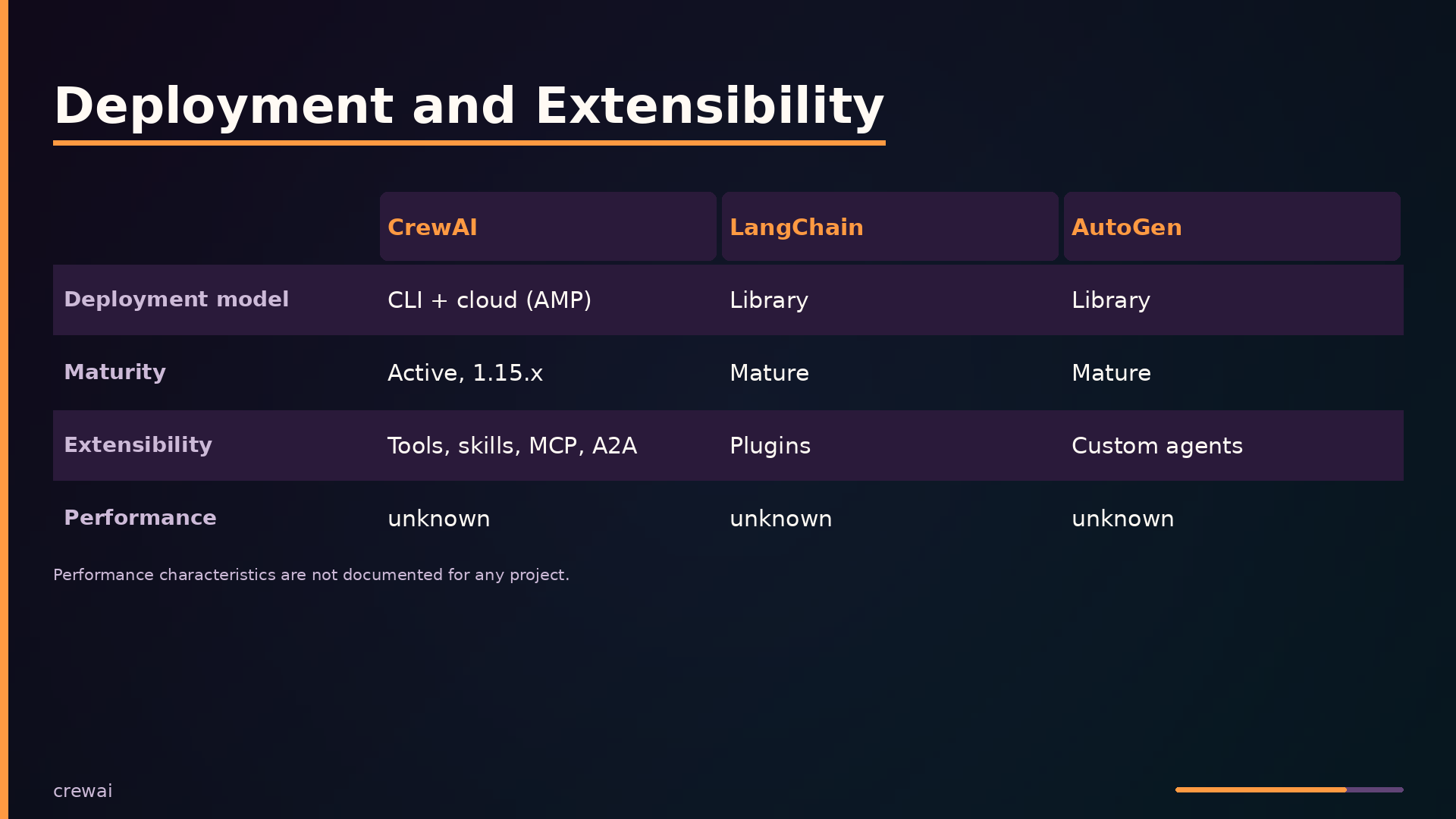
This comparison reflects general knowledge of the four projects and may be out of date. Performance characteristics are unknown for all projects in the digest.
| Axis | CrewAI | LangChain | AutoGen | LlamaIndex |
|---|---|---|---|---|
| Primary use case | Multi-agent orchestration | LLM chains & agents | Multi-agent conversations | RAG pipelines |
| Abstraction model | Crews + Flows | Chains & agents | Conversational agents | Query engines |
| Multi-agent support | First-class | Partial | First-class | Limited |
| Workflow control | Event-driven flows | Chain-based | Conversation-driven | Query-based |
| Tool integration | MCP, custom tools | Broad ecosystem | Custom tools | Data connectors |
| State management | Checkpointed, typed | Memory variables | Conversation history | Index state |
| Deployment model | CLI + cloud (AMP) | Library | Library | Library |
| Maturity | Active, 1.15.x | Mature | Mature | Mature |
| Extensibility | Tools, skills, MCP, A2A | Plugins | Custom agents | Data loaders |
| Performance | unknown | unknown | unknown | unknown |
The key differentiator is orchestration philosophy. CrewAI is orchestration-centric: role-based agents collaborate in crews, and event-driven flows provide deterministic branching with typed, checkpointed state. LangChain is a broader ecosystem where chains and agents compose LLM calls, but multi-agent patterns are not the core abstraction. AutoGen treats conversation as the primary primitive, which suits exploratory interactions but is less structured for production workflows. LlamaIndex is data-centric, with retrieval and query engines at the center and agent orchestration as a secondary concern.
CrewAI’s first-class multi-agent support and event-driven flows are its strongest differentiators. LangChain offers a wider integration surface; AutoGen excels at free-form agent dialogue; LlamaIndex dominates data connectivity. None of the four projects document performance characteristics in the digest.
Under the Hood: Event Bus, Checkpointing, and MCP Client
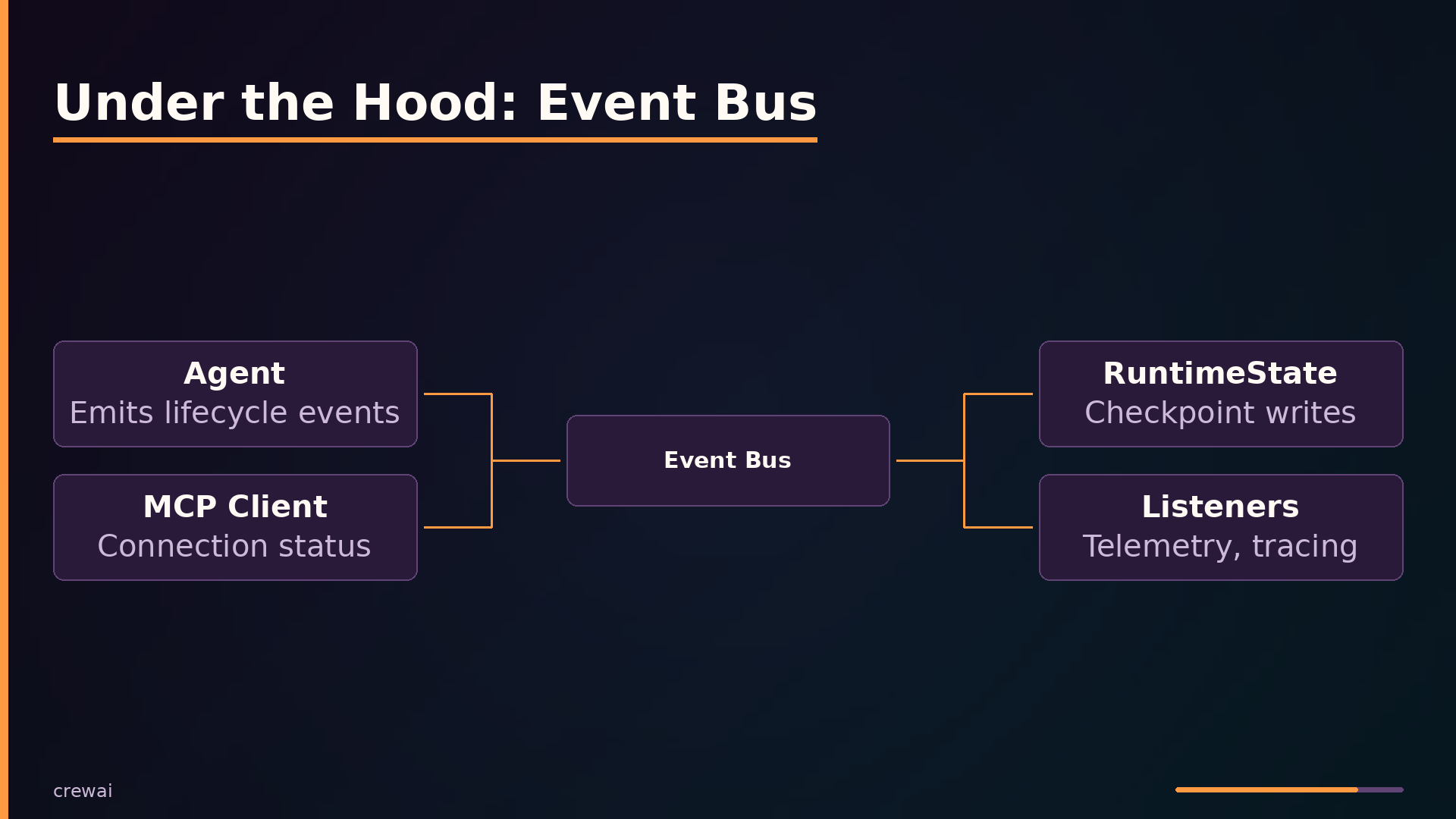
CrewAI’s production readiness rests on several internal mechanisms that operate beneath the public API. The event bus in lib/crewai/src/crewai/events/event_bus.py provides a centralized crewai_event_bus.emit() call that accepts typed pydantic events. Components emit lifecycle events—agent started, MCP connection completed, checkpoint written—without knowing which listeners consume them. This decouples telemetry, logging, and tracing from core execution logic.
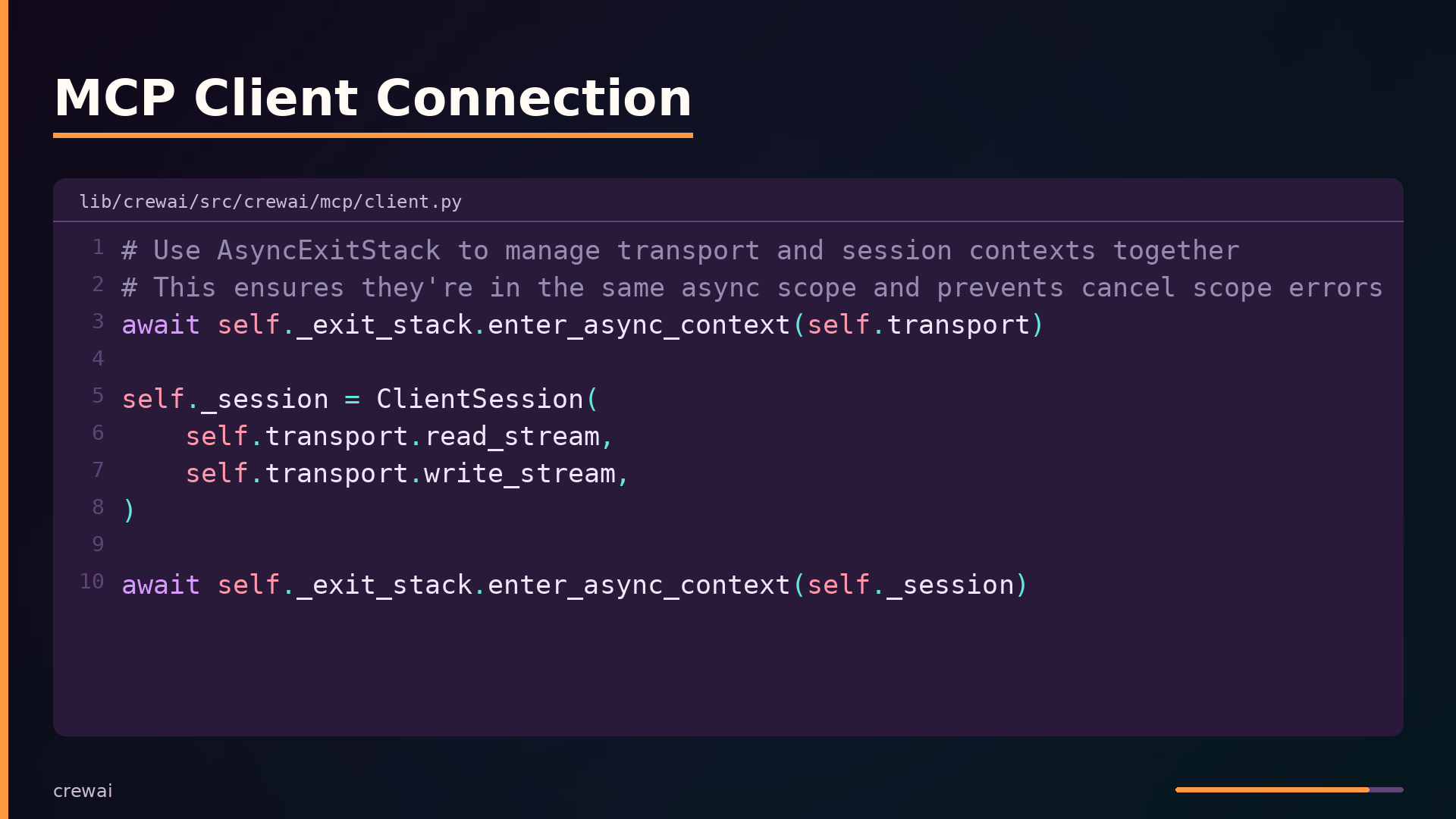
The MCP client in lib/crewai/src/crewai/mcp/client.py demonstrates careful connection handling. It uses an AsyncExitStack to manage transport and session contexts in the same async scope, preventing cancel-scope errors during teardown:
| |
The client wraps operations in _retry_operation(), which applies exponential backoff (wait_time = 2**attempt) and classifies errors as retryable or fatal. Authentication failures raise immediately; timeouts and transient network errors retry up to max_retries (default 3). The client supports stdio, HTTP, and SSE transports, each with its own timeout constants.
Checkpointing relies on RuntimeState._migrate() in lib/crewai/src/crewai/state/runtime.py, which applies version-based transformations to serialized state. This allows older checkpoints to load in newer framework versions. The ChromaDBClient in lib/crewai/src/crewai/rag/chromadb/client.py wraps collection mutations in a cross-process lock from crewai_core.lock_store, serializing writes across processes. Skill and tool installers validate archive member paths before extraction, mirroring tarfile’s filter='data' protection against path traversal.
What to take away
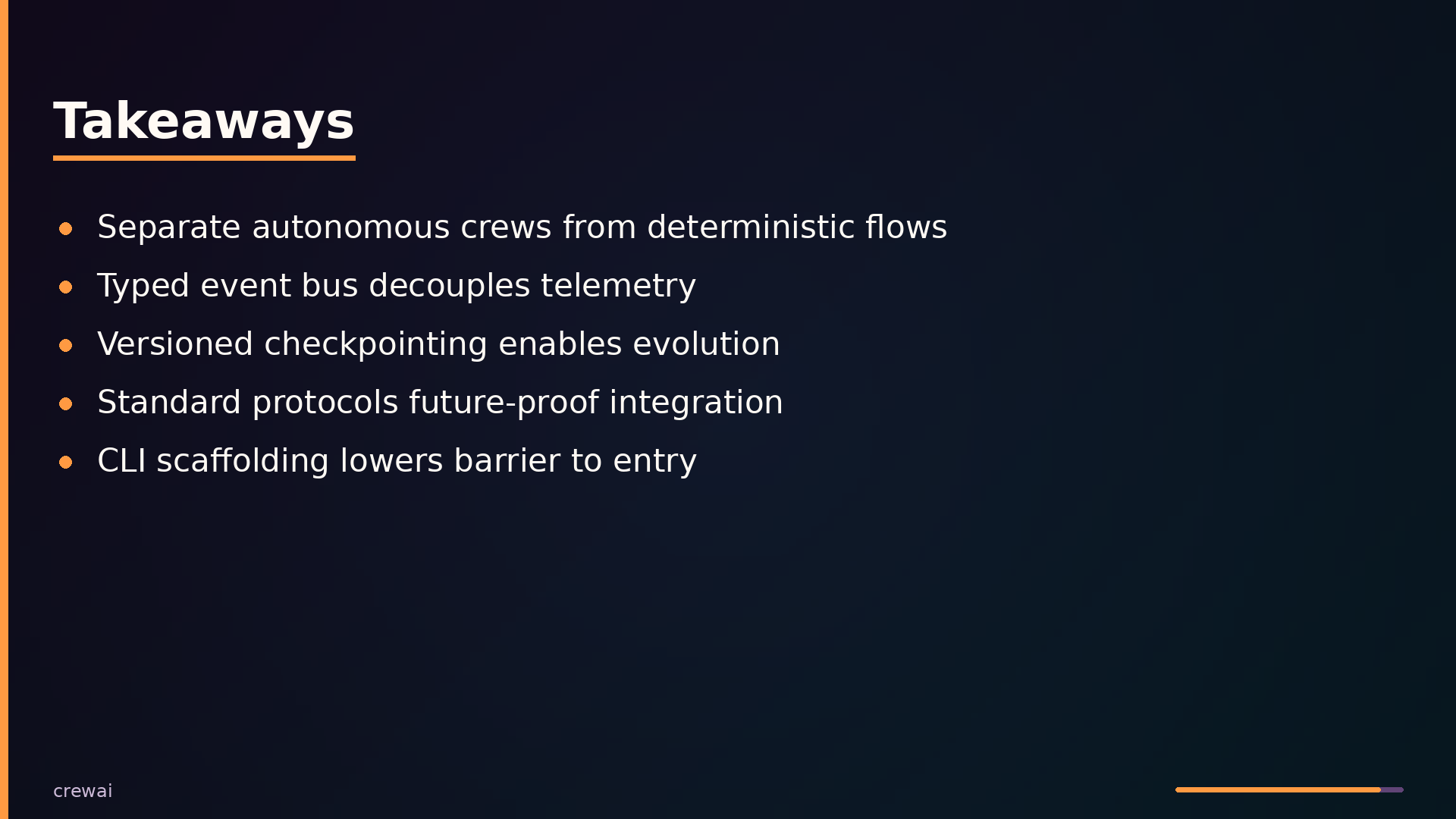
CrewAI’s central design lesson is the separation between autonomous crews and deterministic flows. Crews give agents role-based freedom to collaborate on tasks; flows give developers event-driven control over execution paths, state, and branching. Neither abstraction is sufficient alone, and the framework’s strength is that both are first-class rather than bolted on.
The typed event bus is a transferable pattern worth copying in any agent system. By emitting pydantic-validated lifecycle events from every component, CrewAI decouples core execution from telemetry, tracing, and logging. You can observe what agents do without threading logging calls through every method.
Versioned checkpoint serialization is the second pattern to steal. RuntimeState writes a self-contained JSON snapshot of all active entities with migration hooks, which means long-lived agent systems can evolve their internal schemas without breaking resumability. If you build stateful agent workflows, plan for schema versioning from day one.
The framework’s adoption of MCP and A2A is strategically sound: standard protocols future-proof tool and agent integration. But the A2A implementation is young, and the open-source code does not document performance under load. The commercial AMP suite covers deployment and governance, which the OSS alone lacks.
CrewAI is worth evaluating when you need both collaborative agents and deterministic orchestration in Python. The repository is at github.com/crewAIInc/crewAI.
What this analysis could not determine
- The exact behavior of the AgentExecutor (experimental) compared to CrewAgentExecutor is not fully detailed in the digest.
- The performance characteristics of the framework under load are not documented in the digest.
- The full extent of the Plus API and enterprise features is not visible from the open-source code.
- The A2A and A2UI implementations are relatively new; their stability and adoption are unclear.
- The exact dependency versions and their compatibility constraints are not fully enumerated.
Further diagrams